
Showing posts with label China. Show all posts
Showing posts with label China. Show all posts
Monday, April 22, 2013
BRICS Nations Plan New Bank to Bypass World Bank, IMF
Mike Cohen & Ilya Arkhipov - Mar 26, 2013
http://www.bloomberg.com/news/2013-03-25/brics-nations-plan-new-bank-to-bypass-world-bank-imf.html
The biggest emerging markets are uniting to tackle under-development and currency volatility with plans to set up institutions that encroach on the roles of the World Bank and International Monetary Fund.
The leaders of the so-called BRICS nations -- Brazil, Russia, India, China and South Africa -- are set to approve the establishment of a new development bank during an annual summit that began today in the eastern South African city of Durban, officials from all five nations say. They will also discuss pooling foreign-currency reserves to ward off balance of payments or currency crises.
“The deepest rationale for the BRICS is almost certainly the creation of new Bretton Woods-type institutions that are inclined toward the developing world,” Martyn Davies, chief executive officer of Johannesburg-based Frontier Advisory, which provides research on emerging markets, said in a phone interview. “There’s a shift in power from the traditional to the emerging world. There is a lot of geo-political concern about this shift in the western world.”
The BRICS nations, which have combined foreign-currency reserves of $4.4 trillion and account for 43 percent of the world’s population, are seeking greater sway in global finance to match their rising economic power. They have called for an overhaul of management of the World Bank and IMF, which were created in Bretton Woods, New Hampshire, in 1944, and oppose the practice of their respective presidents being drawn from the U.S. and Europe.
Reform Needed
“We need to change the way business is conducted in the international financial institutions,” South African International Relations Minister Maite Nkoana-Mashabane said in a March 15 speech in Johannesburg. “They need to be reformed.”
The U.S. has failed to ratify a 2010 agreement to give more sway to emerging markets at the IMF, while it secured Jim Yong Kim, an American, as head of the World Bank last year over candidates from Nigeria and Colombia.
Finance ministers and central bank governors from the BRICS nations, who met in Durban today, agreed to set up currency crisis fund of about $100 billion, Brazilian Finance Minister Guido Mantega told reporters today. He didn’t give details of proposed funding for the new bank, which Brazil wants established by 2014. The nation’s leaders are due to sign a final accord tomorrow.
FDI Inflows
Goldman Sachs Asset Management Chairman Jim O’Neill coined the BRIC term in 2001 to describe the four emerging powers he estimated would equal the U.S. in joint economic output by 2020. Brazil, Russia, India and China held their first summit four years ago and invited South Africa to join their ranks in December 2010.
Trade within the group surged to $282 billion last year from $27 billion in 2002 and may reach $500 billion by 2015, according to data from Brazil’s government. Foreign direct invesment into BRICS nations reached $263 billion last year, accounting for 20 percent of global FDI flows, up from 6 percent in 2000, the United Nations Conference on Trade and Development said on its website yesterday.
“If they announce a BRICS bank it will be quite something,” O’Neill said in an e-mailed reply to questions on March 15. “At a minimum it symbolizes they can achieve something as political group and means lots of other things could follow in the future. It also means that they will have their own kind of special World Bank, which may aid infrastructure and trade projects.”
Currency Pool
While BRICS leaders may approve the creation of a development bank in principle at the summit, details on funding and operations may take longer to finalize.
Russia favors capping each side’s initial contribution at $10 billion, Mikhail Margelov, President Vladimir Putin’s envoy to Africa he said in a March 15 interview in Moscow.
“It will be some time before it will be feasible for this bank to start financing say, a railway project,” Simon Freemantle, an analyst at Standard Bank Group Ltd., Africa’s biggest lender, told reporters in Durban yesterday. “That is some way out.”
Interest rates near zero in the U.S., Japan and Europe have fueled foreign investors’ appetite for higher-yielding assets, driving up currencies from Brazil to Turkey. Brazil has warned of a global currency war as nations take reciprocal action to weaken their currencies and protect export industries.
African Leaders
Brazil’s real has gained 1.9 percent against the dollar since the beginning of the year, while South Africa’s rand has dropped 8.7 percent in the period.
For South Africa, which makes up just 2.5 percent of total gross domestic product in BRICS, the summit is a way to showcase its role as an investment gateway to Africa. President Jacob Zuma has invited 15 African heads of state, including Egypt’s Mohamed Mursi and Ethiopia’s Hailemariam Desalegn, for talks with the BRICS leaders at the summit. For most of the BRICS leaders, it’s also the first opportunity to meet Chinese President Xi Jinping after his appointment on March 17.
“We will discuss ways to revive global growth and ensure macroeconomic stability, as well as mechanisms and measures to promote investment in infrastructure and sustainable development,” Indian Prime Minister Manmohan Singh said in a statement yesterday.
To contact the reporters on this story: Mike Cohen in Cape Town at mcohen21@bloomberg.net; Ilya Arkhipov in Moscow at iarkhipov@bloomberg.net
To contact the editor responsible for this story: Nasreen Seria at nseria@bloomberg.net

Tuesday, May 15, 2012
The Fall of Bo Xilai
Full Article:
http://www.businessweek.com/articles/2012-04-10/bo-xilais-fall-complicates-chinas-leadership-transition
Former high-flying conservative Bo Xilai has been suspended from China’s Central Committee, a 200-plus-member top leadership body, as well as the more powerful Politburo, now with two dozen members. The charge: “suspected of being involved in serious discipline violations,” said Xinhua news agency on April 10. And in a stunning development, the state news agency also announced that Bo’s wife, Gu Kailai, and an orderly from the Bo household are “highly suspected” in the homicide of a British businessman who died in Chongqing last November.
It is the biggest political scandal to hit China in years. It destroys any possibility of a smooth transition to the next generation of top leaders slated to take control at the National Party Congress, which will happen this fall. That had been the intention of China’s party brass, eager to present a unified face to the world. And it ends the career of the 62-year-old former party secretary and princeling—son of a Communist Party revolutionary—whose once-likely ascension to China’s Standing Committee would have made him one of the nine most powerful men in the country.
For Bo, it is an ignominious end to a career that earned him occasional kudos and plenty of enemies. He was praised for creating one of China’s most livable cities when he ran coastal Dalian in the 1990s. As minister of commerce from 2004 to 2007, he earned few friends among the foreign business community while gaining a reputation as a nationalist who favored Chinese state enterprises.
Bo’s prospects of reaching top office faded when his former chief of police, Wang Lijun, fled to the U.S. consulate in Chengdu, Sichuan, in an apparent failed bid for political asylum. Now it appears Wang carried with him explosive allegations about Bo’s wife’s involvement in the Chongqing murder, effectively ending any possibility of Bo ever being promoted again. The unfolding scandal saw him replaced as Chongqing’s party secretary earlier, on March 15...
Tuesday, March 20, 2012
Foxconn's Other Dirty Secret: The World's Largest 'Internship' Program
Alex PasternackWednesday, Feb 15, 2012
http://motherboard.vice.com/2012/2/15/foxconn-s-other-dirty-secret-the-world-s-largest-internship-program
In June 2010, a university student named Liu Jiang arrived in the southern Chinese city of Foshan to begin his summer internship, at a factory that produces LCD screens for laptops and cell phones for the manufacturing giant Foxconn. As a student at the Dongfang Vocational School of Technology in the northern city of Shijiazhuang, Liu had traveled hundreds of miles for a chance to get hands-on experience working for China’s leading electronics maker.
But his internship was brief. Less than a month later, in the early morning of July 18, the eighteen-year-old would climb to the roof of his six-story dormitory and leap to his death.
Liu quickly became a statistic in Foxconn’s ugly worker history, a blip on the Internet radar: his was the seventeenth suicide attempt, and the thirteenth death, at a Foxconn factory that year alone. (The suicide rate at Foxconn is still lower than that of the general population in China, but striking for its concentration among a group of workers at a single company.) Apart from his school, few details emerged about Liu’s life or the conditions of his particular internship, a gig that landed him among other full-time workers his age and younger.
But in light of a series of reports that have emerged in the years since, Liu’s suicide points at one of the under-reported but more unsavory aspects of the much-criticized labor practices that produce gadgets for Apple and many other popular computer brands: with the help of schools and government officials, the company runs a massive internship program built not on voluntary education but on “compelled” factory work for teenage students. According to Ross Perlin, author of Intern Nation, Foxconn may be running “the world’s single largest internship program – and one of the most exploitative.”
By Foxconn’s standards, Liu’s internship — which he landed through a labor placement firm in the nearby city of Guangzhou — would have included housing, food, and a small stipend estimated to be about half the salary of a typical factory worker, all in the name of hands-on education. But according to independent studies, and by Foxconn’s own admission, interning in a gadget factory is often less about job training and more of a lesson in the crude economics of globalization.
Foxconn says it relies on as many as 180,000 interns during the summer months to fulfill the needs of the voracious beast of Western gadget demand — and the requirements of companies like Apple, Amazon, HP and nearly every other major electronics brand. The Hong Kong-based Students and Scholars Against Corporate Misbehavior (SACOM), a longtime critic of Foxconn, estimates the number is much higher, and that interns have at times made up as much as a third of the company’s 1.3-million-strong workforce, or 430,000 interns. Either way, it’s an intern workforce more sizable than Disney, Congress and Hollywood combined.
But neither Apple nor recent widely-spread reports in the mainstream media make mention of interns. Sourced from schools and third-party recruitment firms, SACOM reports that interns tend to fall into a class of indirect workers, for whom Foxconn is not directly responsible. At the time of Liu’s death, Foxconn deflected responsibility for his case because he was hired by an outside recruitment company in Guangzhou.
“Because [indirect workers] are not directly hired by the factories, the factories will say, ‘we are not responsible for taking care of them,’” Fan Yuan, of the New York-based China Labor Watch, told me. “They usually work longer hours than regular workers. If there is an inspection or auditing from these companies, these workers will disperse.”
As a result, the use of interns can complicate attempts to surveil the supply chain for labor violations. “If we want to dig deeper, if we want to find the factories that are selling raw materials to Foxconn, in these factories the conditions may be even worse,” says Yuan. “But it’s really difficult for any organization to have specific data about them.”
This isn’t the venerated internship of the privileged college student, building valuable work and life skills with school credit and on-the-job training in place of pay – if such an internship even still exists. Historically, Foxconn’s low-wage internships involve essential factory labor by poor students, some of whose areas of study have nothing to do with electronics, and turn the “school credit” idea on its head. According to SACOM, vocational students, including those studying journalism, tourism and languages, have had practically no choice but to participate in such internships if they want to graduate from their schools. As temporary workers, they have little legal protection or recourse in the event of injury, over-work, or underpayment. And if they complain, they could jeopardize their diplomas.
“It is evident that this use of student workers is a form of involuntary labour, which is supposedly prohibited by Apple,” says a recent letter by SACOM to Apple’s CEO, Tim Cook. Apple, which is only one of dozens of Western brands that contract to Foxconn, has taken steps to address concerns at the manufacturer, including threats to workers’ health and safety, a heavy emphasis on overtime, and the use of underage workers. This week Apple announced, to some skepticism, that the independent auditor Fair Labor Watch was beginning to examine the company’s supply chain.
Apple’s most recent 27-page Supplier Responsibility Report, however, makes no mention of student internships. And while Foxconn’s internships have been reported in Chinese media, in Perlin’s book and in a recent Alternet story, student workers were not mentioned in recent reports by the Times, This American Life and others.
School work
Even if Foxconn is the largest employer of interns, the system is far larger than Foxconn, and depends upon the collusion of local governments and schools. Observers like the Hong Kong-based China Labor Bulletin and SACOM say the system is abetted by a network of government officials, who are paid fees for recruiting students, work with an unruly system of public and private vocational schools that funnel students into internships and reap fees and other benefits in the process. Such schools have proliferated across the country in recent years, often targeting rural and low-income high school graduates not privileged or accomplished enough to make it through the testing gauntlet and enter China’s middle- and top-tier universities.
On June 26, 2010, a week after Liu Wang began his internship in Foshan, the official China Daily newspaper described a striking approach to labor supply at Foxconn, which was then reeling from a string of suicides and rising labor demands. The Henan provincial government declared that 100,000 vocational and university students would be sent on three-month internships at Foxconn’s Shenzhen plants.
At one vocational school in Zhengzhou, wrote Hu Yinan, students were informed of the government’s requirement after the summer semester had begun, and that “all those who refuse would have to drop out.” That elicited ironic resignation from at least one student who spoke to the paper: “Everybody is going, ‘I can go find out why all those Foxconn employees killed themselves.’ It’s kind of fun.”
Meanwhile, a study that year by Beijing University and Tsinghua University found that local government agencies were given recruitment fees in exchange for filling worker quotas. One student interviewed for the study said she and 30 other students were dispatched from a vocational school in Guizhou Province to intern at an electronics factory in Changzhou, Jiangsu. There they were paid 500 yuan per month, half the pay of an average Foxconn worker, over the course of four months, with their internships tied to their eligibility for graduation.
In exchange for sending interns, schools are compensated, to the detriment of the interns: “it was not unusual for schools to deduct a ‘commission’ from the interns’ salary or get paid directly by factories for providing cheap labour,” according to the 2011 report by China Labor Watch.
The 2010 report concluded that Foxconn was “systematically” abusing internships offered by over 200 vocational schools in Southern China since 2009. Rather than performing “training”-related tasks, they were pressed into factory work, in some instances, forced to work 14-hour days in a standing position with low pay. Foxconn, it said, was as a “concentration camp of workers in the 21st century,” with students “kidnapped” to work overtime in the name of “just in time” production.
The “Internship”
The appeal of internships to employers at Chinese factories is not unlike that for many employers at white-collar offices in Los Angeles or London: free or low-cost labor by eager, energetic workers who earn few, if any, benefits, doing essential work. In China, where the “internship” has migrated from the West, Foxconn may be the tip of the iceberg. “What Foxconn and Apple’s other Chinese suppliers do—and Apple’s willingness to tolerate it—is completely par for the course for manufacturing in China,” says Perlin, who’s spent years working and studying in the country. “Forced labor is a major part of the Chinese economy, in many different respects, and our dependence on Chinese goods binds us to that every day. Forced internships like the ones at Foxconn appear to be somewhat common as well. What may be different here is the scale and the high-level government collusion.”
Since the 2010 suicides, Foxconn has pledged to improve its approach to interns, in addition to pay and worker safety. In an October 2010 statement, Foxconn responded to SACOM’s claim that a third of its workforce was interns, insisting that interns comprised 7.6% of its total employee population in China, “and at no time has this percentage ever exceeded 15% even during the summer peak seasons.”
“While we have found a small number of incidents where interns have voluntarily and legally worked overtime hours,” read the statement, “we are working hard to institute a ban on any overtime work by interns and we are in the process of ensuring that this important policy is enforced across all of our operations.” For its internships – “short-term, on-the-job” training managed by individual schools for students aged 16 and up – compensation levels are now “equivalent to that of the basic workers and higher than the government regulated levels and the average internship period is between two and six months.”
In the electronics industry, which has been called the most labor-abusive in the world, internships are not often addressed, even though guidelines by Apple and others forbid unpaid work and stipulate minimum pay. But those guidelines can mean little in practice when operations like Foxconn are squeezed at the margins to provide unpredictable, overnight deliveries of new products. The tide may be turning though, as a groundswell of labor unrest – and the uncensored reporting of labor abuses by the Chinese press – seem to illustrate.
Though Foxconn raised wages in 2010, they’re still reported to be 50-60 percent of the minimum living wage of the cities where factories are based, according to SACOM. That means overtime is necessary. One student worker in Chengdu explained, “If there is no overtime at all, I will only receive the basic salary. Hence, I have no choice.”
To young workers from the countryside, the ability to work long hours, even in violation of local labor laws, can be seen as a benefit. But the costs are high. Following the string of suicides, an undercover report published by China’s leading investigative newspaper, Nanfang Zhoumo (Southern Weekend), laid bare the grim circumstances: 300,000 employees working and living on a 2 square kilometer patch of land – three times the population density of Manila, the densest city in the world – with ten workers to a dorm room, and little to no time for relationships (cheap prostitutes tend to set up shop just outside the factories). The coverage was excellent (part one, two and three), perhaps because its reporter, Liu Zhiyi, was able to fit in so well with the young workers: he too was a 23 year old intern for the newspaper.
“I know of two groups of young people,” was how he started his first article. “One group consists of university students like myself, who live in ivory towers and are kept company by libraries and lake views.”
The other group are treated more like robots. “They often dream, but also repeatedly tear apart their dreams, like a miserable painter who keeps tearing up his or her drafts,” he wrote. "They manufacture the world’s top electronic products, yet they gather their own fortune at the slowest possible pace. The office’s guest network account has a password that ends with “888” — like many businessmen, they love this number, and they worship its homonym [“rich,” “lucky”]. Little do they know that it’s their own hands protecting the country’s “8,” as their overtime hours, lottery tickets, and even horse racing bets struggle to find the “8” that belongs to themselves."
Few protections
In China, where inflation is colliding with higher wages, and placing a stronger reliance on white-collar internships, few protections for interns exist. Because interns are classified as students rather than workers, they are not protected by the country’s Labor Contract Law or other labor laws. Guidelines issued by the Ministry of Education and other government departments that do govern internships “do not necessarily carry the weight of law,” according to a report by the China Labor Bulletin.
A report published in 2011 by the Chinese Ministry of Education emphasized that the nation’s goal was to improve the supply of skilled workers to a distressed labor market – not necessarily to protect the rights of student interns and workers. “China has entered a critical moment of economic and social development,” it read. “However, secondary vocational education, which is supposed to shoulder the responsibility of cultivating China’s skilled workers, is still weak. Its quality, structure, scale and efficiency have yet to catch up with social and economic development.”
The lack of protections for interns is widespread. Because interns are not permanent workers, a range of employers, from Foxconn to Fox Searchlight – which has recently been named in a class-action lawsuit over “The Black Swan” – can ultimately deflect responsibility.
In October, a spokesman for Fox pointed the finger at director Darren Aronofsky: “These interns were not even retained by Fox Searchlight … which has a proud history of supporting and fostering productive internships.” After Liu’s suicide in July 2010, a spokesman for Foxconn said that because the victim was not an official employee of Chimei Innolux, but a temporary worker employed by a labor dispatching firm, it would not be “handling” the case.
In that same statement, Foxconn revealed that Liu’s internship had been terminated about a week after it began, on July 7, because he failed to show up for work for several days, and that the company had been trying to arrange to have him sent back to his hometown. It’s not clear why he stopped working, what kept Foxconn from buying him a ticket home, or what led him to suicide.
But Liu’s death might be read as the stark sign of an abusive practice that stretches far beyond China’s factories. And it’s another reminder, if we needed one, that calculating the cost of a new gadget is much harder than the price tag suggests.
Editor’s note: Liu Jiang is an alias. Liu is the surname of the intern who died in 2010, but his given name could not be confirmed.
When will workers share in Apple's wealth?
Scott Nova, Special to CNNFri February 17, 2012
http://www.cnn.com/2012/02/17/opinion/nova-apple-foxconn
STORY HIGHLIGHTS
Scott Nova: Labor rights problems at Apple's supplier factories an issue for years
Apple joined an organization called the Fair Labor Association to audit its supply chain
Nova: If Apple wants to improve labor practices, it should reach out to independent groups
Nova: If Apple genuinely "cared about every worker," it would pay every worker a living wage
Editor's note: Scott Nova is executive director of the Worker Rights Consortium, an independent, nonprofit labor rights-monitoring organization that investigates working conditions in factories around the world.
(CNN) -- Apple's CEO Tim Cook says the company "cares about every worker" in its factories and that "no one in (the) industry is doing more to improve working conditions than Apple."
Of course, when it comes to issues of corporate responsibility, talk is cheap. What matters is not what Apple says, but what it does.
And what Apple does in its vast global supply chain has been well-documented, which is why the company is in public relations overdrive, frantic to protect its once pristine corporate image.
Consider the fate that befell workers at a factory in Chengdu, China, that makes products for Apple. In May, independent investigators issued a report documenting grave dangers to workers at the facility. They warned the factory was failing to control the profusion of dust produced by the manufacture of aluminum cases for the Ipad 2. When a factory is suffused with aluminum dust, there is a high risk of explosion. Apple ignored the report and refused to meet with the authors, the investigators said. It did nothing to address the danger.
Two weeks later, the factory exploded, killing four workers and injuring 18. In the wake of the explosion, Apple said its suppliers took measures to control aluminum dust. But despite this, in December 2011, another explosion, at an Apple supplier factory in Shanghai, injured 61 workers.
Grievous labor rights problems at Apple's supplier factories have been known for years, including the spate of worker suicides in 2010 at the giant plant in Shenzhen, China, known as "Ipod City." At this factory -- owned, like the Chengdu plant, by Apple's biggest supplier, Foxconn -- more than a dozen workers took their own lives by throwing themselves from the roof of the factory's overcrowded dormitories, in apparent protest of the brutal treatment facing workers at the facility. (Foxconn reportedly responded by putting up nets outside the dorms and making workers sign pledges not to kill themselves.)
In recent weeks, public awareness of these issues has increased exponentially, thanks to a huge jump in media interest, raising Apple's public relations problems from a low simmer to a rolling boil.
When a company comes under this kind of pressure, sometimes genuine change in policy can occur. The more typical response is a mere change in rhetoric. This is the route Apple is choosing.
Apple's major move has been to announce that it has joined an organization called the Fair Labor Association, which will "audit" Apple's factories. According to Apple, the Fair Labor Association is an independent watchdog that will work tenaciously to hold Apple and its suppliers accountable.
Unfortunately, while there are some fine people at the association, the organization is not the independent watchdog Apple claims it to be. Indeed, most of its money -- millions of dollars per year -- comes from the very companies whose labor practices it is supposed to scrutinize. Although Apple has not disclosed its financial relationship with the Fair Labor Association, it is likely now the organization's largest funder. Moreover, on the association's board of directors sit executives of major corporations such as Nike, Adidas and agribusiness giant Syngenta. The job of these executives is to represent the interests of other member companies, such as Apple. Under the Fair Labor Association's rules, the company representatives on the board exercise veto power over major decisions.
Independence, as most people understand the term, means an organization is not funded and governed by the companies it is charged with investigating. Despite the financial relationship, Apple argues that the Fair Labor Association will act independently and that the association's review of Apple's factories will probably be "the most detailed factory audit in the history of mass manufacturing."
Early indications are not encouraging. Just one day after launching what was supposed to be a long and uncompromising investigation of Foxconn's Ipad plant in Shenzhen, the association was already issuing public praise of Foxconn and Apple.
On Wednesday, CNNMoney/Fortune ran an article with the headline, "Apple iPad plant is 'way, way above average,' says inspector." Fair Labor Association President Auret van Heerden said this about Foxconn to Reuters: "The facilities are first-class. ... I was very surprised when I walked in the door how tranquil it is. ..." The CNNMoney/Fortune article notes that "whether intended or not, van Heerden's remarks served to support (Apple CEO) Cook's contention that no one has done more than Apple to address the working conditions at factories."
Van Heerden reached these conclusions after a guided tour of the factory provided by Foxconn's owner, Terry Gou. The views of Gou, one of the wealthiest men in Asia, are well-known to Foxconn workers because, as punishment for displeasing their managers, workers are sometimes forced to spend hours writing out copies of his personal sayings. Clearly, Apple's partnership with the Fair Labor Association is not, in and of itself, going to usher in radical change.
So what steps would Apple take if it were genuinely committed to improving its labor practices? For starters, it would open its factories for inspection and worker trainings to genuinely independent groups such as Hong Kong-based SACOM, the organization whose report on the Chengdu factory could have saved the lives of the workers killed there in May, had Apple paid it heed.
And if Apple genuinely "cared about every worker," it would pay every worker a living wage -- enough for workers to achieve a minimally decent standard of living, support their families and even save a bit toward a better future. Today, barely 1% of the retail price of an Ipad goes to the workers who make it; 33% goes to Apple's profits. Apple's profits are so high, and its global labor costs so low, that it could triple the wages of its 700,000 manufacturing workers and help them achieve a living wage (just a few dollars an hour in China), and still make $40 billion a year. A wage increase of 16% to 25% at Foxconn, announced today as Apple's public relations blitz reaches a crescendo, doesn't come close.
Next time you are at the Apple Store, consider bellying up to the Genius Bar and asking why the most profitable company in the history of technology can't pay its workers a living wage and why, if Apple is really ready to open itself to independent scrutiny, it doesn't allow inspections by organizations in which it is not a dues-paying member.
Apple Partner Foxconn Has ‘Tons of Issues,’ Labor Group Says
Peter BurrowsFeb 17, 2012
http://www.bloomberg.com/news/2012-02-17/foxconn-auditor-finds-tons-of-issues-.html
The Fair Labor Association, a watchdog monitoring working conditions at makers of Apple Inc. products, has uncovered “tons of issues” that need to be addressed at a Foxconn Technology Group plant in Shenzhen, China, FLA Chief Executive Officer Auret van Heerden said.
Van Heerden made the comments in a telephone interview after a multiday inspection of the factory. Apple, the first technology company to join the FLA, said on Feb. 13 that it asked the Washington-based nonprofit organization to inspect plants owned by three of its largest manufacturing partners.
“We’re finding tons of issues,” van Heerden said en route to a meeting where FLA inspectors were scheduled to present preliminary findings to Foxconn management. “I believe we’re going to see some very significant announcements in the near future.”
He declined to elaborate on the findings. The FLA plans to release more information about its inspection in the coming weeks. By then, the company will have had a chance to contest or agree to steps to prevent further violations.
“Foxconn is cooperating fully with this audit and we will review and act on all findings and recommendations,” Foxconn said in an e-mailed statement today. “This is a very professional and thorough review and any deficiencies the FLA might find in the implementation of customer or Foxconn policies will be addressed.”
Steve Dowling, a spokesman for Cupertino, California-based Apple, referred to the company’s Feb. 13 statement about the audits.
Hard-to-Find Violations
Van Heerden said in an interview with Reuters published Feb. 15 that Foxconn’s plants were “first class.” He said he was surprised “how tranquil it is compared with a garment factory.”
Heather White, the founder of Verite, another monitoring group, said that many alleged violations -- say, forced overtime or use of certain toxic chemicals -- can be hard to detect.
“Those are not things one would see on a hosted tour that was planned in advance,” she said.
Van Heerden said the comments reflected his previous interactions with Foxconn.
Apple had commissioned the FLA to carry out smaller projects in the past two years, in order to try out some of the inspection techniques used by the group to more effectively root out workplace problems.
Responses to Hazards
Van Heerden said he had been impressed with Apple and Foxconn’s responses to hazards related to the polishing of aluminum, which led to explosions at Foxconn and another Apple supplier, Pegatron Corp. (4938), that killed at least three workers and injured more than 70 people last year. Van Heerden said that Apple researched the problem and hired a respected consultant.
Apple shares were little changed at $502.12 yesterday. The stock has risen 24 percent this year, extending Apple’s lead as the world’s most valuable company.
In response to the consultant’s recommendations, Foxconn bought state-of-the-art extraction and ventilation equipment to prevent dust buildup, and developed an automated approach so that no humans are involved in the polishing work.
“I’ve seen the improvements that have been made, and they’re dramatic,” he said. “The room is full of robots. It’s totally automated. But people need to see the proof.”
Random Interviews
Van Heerden said that FLA’s 30-person inspection team will interview 35,000 Foxconn employees, via meetings with small groups of randomly picked workers, chosen to reflect the demographics of the campus in terms of age, gender and skill levels. As part of the process, workers log answers to questions on tablets connected to FLA servers so they can be tabulated.
White, who is now a fellow at Harvard University’s Edmond J. Safra Center for Ethics, says group meetings on Foxconn’s premises may not yield honest responses. She says she found it more productive to talk to workers in their homes or other off- site locations.
“It’s very hard to get people to speak openly about very serious issues,” she said.
To contact the reporter on this story: Peter Burrows in San Francisco at pburrows@bloomberg.net
To contact the editor responsible for this story: Tom Giles at tgiles5@bloomberg.net
Foxconn Plans to Lift Pay Sharply at Factories in China
DAVID BARBOZAFebruary 18, 2012
http://www.nytimes.com/2012/02/19/technology/foxconn-to-raise-salaries-for-workers-by-up-to-25.html
BEIJING — Foxconn Technology, one of the biggest manufacturers of products for Apple, Dell, Hewlett-Packard and other electronics companies, said Saturday that it would sharply raise worker salaries at its Chinese factories.
Foxconn said that salaries for many workers would immediately jump by 16 to 25 percent, to about $400 a month, before overtime.
The company also said it would reduce overtime hours at its factories.
Labor rights groups say that over the years, many Foxconn plants have violated Chinese labor laws by pushing workers to endure excessive amounts of overtime.
Criticism has grown over working conditions at several Apple suppliers in China, including Foxconn, which employs more than one million workers to assemble some of the world’s most popular devices.
Apple announced last Monday that the Fair Labor Association, a nonprofit group, would provide independent audits of its supplier factories in China and elsewhere. Apple said the group’s findings would be made public. The association began inspecting Foxconn operations in China this week.
Apple and Foxconn, which is based in Taiwan, have strongly denied allegations that the workers are treated poorly. But Apple has acknowledged in its own audits that some of its suppliers in China violate Apple’s own code of conduct, with instances of child labor, forced overtime and unsafe working conditions and evidence that employees are sometimes exposed to hazardous and toxic chemicals.
In recent years, Foxconn facilities in China have experienced a series of worker suicides, and labor rights groups have documented varied abuses.
Last year, four workers were killed and about 20 were injured because of a dust explosion at a Chinese factory that was producing the Apple iPad.
According to Bloomberg News, the auditor at the Fair Labor Association said recently that he had already found “tons of issues” at Foxconn plants. He did not detail the problems.
A Foxconn spokesman could not be reached late Saturday.
A version of this article appeared in print on February 19, 2012, on page A14 of the New York edition with the headline: Foxconn Plans To Sharply Lift Workers’ Pay.
Wednesday, February 29, 2012
Apple’s Foxconn Auditing Group ‘Surrounded With Controversy’
Apple’s Foxconn Auditing Group ‘Surrounded With Controversy,’ Critics Say
Christina Bonnington
February 13, 2012
http://www.wired.com/gadgetlab/2012/02/apple-foxconn-investigations
Following ongoing public outcry and organized protests at Apple stores last week, Apple has announced that an organization called the Fair Labor Association is conducting independent assessments of worker conditions inside the factories of Foxconn, its manufacturing partner in China.
The FLA audit began this morning in Shenzen’s “Foxconn City.” In the inspections, FLA representatives will interview thousands of factory employees about their living and working conditions, delving into topics such as compensation, health and safety, working hours, and the workers’ communication with management. The results of the inspections will be posted on the FLA’s website in early March.
“We were hoping for a quick response, but I don’t know if we were actually expecting such a fast response from Apple,” said Sarah Ryan, a human rights organizer at Change.org, one of two groups that orchestrated last week’s protests at Apple stores. “It’s especially exciting that these audits are going to be transparent and public.”
The FLA said the audits will be conducted by “a team of labor experts” composed of FLA staff and representatives from two accredited service providers, Openview and INFACT. They’ll be visiting another Foxconn facility in Chengdu, China in the coming weeks.
While encouraged by today’s Apple announcement, Ryan also conceded the FLA is “surrounded with controversy in terms of effectiveness and objectiveness.” Still, Ryan says Change.org recognizes Apple has an existing relationship with the FLA, and as long as its findings are open and transparent, that’s a good thing.
But another key advocate of the Foxconn workers was even less impressed with Apple’s Monday announcement. Taren Stinebrickner-Kauffman, executive director of SumOfUs.org, told Wired, “We’re hopeful that this is a step towards the solution, but it’s not even close to the solution itself. The FLA does not have a great track record of conducting effective investigations.”
SumOfUs and Change.org co-sponsored a petition asking Apple to respond to allegations of Foxconn worker abuse, and to commit to developing “ethical” products. More than 250,000 people signed the petition, which was hand-delivered to Apple Stores across the globe on Thursday morning. A second petition, from Hong Kong group SACOM, takes last week’s protest one step further by outlining five specific areas in which Apple needs to improve, including ending the use of student workers and providing a living wage for factory employees.
Although knowledge of poor working conditions inside Foxconn has existed for years, after Apple’s record earnings in 2011, the issue struck a big nerve with much of the public. A New York Times piece that highlighted some of the dire conditions inside Apple’s Chinese factories motivated people to start taking action against the status quo.
The new FLA investigations, detailed in an Apple press release, appear to be a direct response to this outcry. Apple has conducted more than 40 supply chain audits of Foxconn since 2006 and over 500 audits of its factories total.
“We believe that workers everywhere have the right to a safe and fair work environment, which is why we’ve asked the FLA to independently assess the performance of our largest suppliers,” Tim Cook, Apple’s CEO, said in the release.
“As an Apple consumer, I’m relieved to hear that Tim Cook is taking this seriously and is breaking ground in the industry with Fair Labor Association auditing,” said Mark Shields, the consumer who originally launched the Change.org petition, in a statement. “But Apple still needs to use some of their trademark creativity and problem solving to create a worker protection plan for new products — especially the upcoming iPad 3 — so that they’re proactively taking care of their workers.”
But for those looking for Apple (as well as other tech companies) to really change their ways, the FLA may not be the best company to perform these assessments, if its history is anything to go by.
Stinebrickner-Kauffman pointed out a site called FLA Watch that’s dedicated to monitoring the company’s well-publicized audits. It calls the FLA “a public relations mouthpiece” for corporations (particularly the apparel industry).
“The FLA was created in response to student protests around the sweatshop issue in the late 90s, specifically to monitor garment shops, with NIKE as a founding member,” Teresa Cheng, international campaigns coordinator with United Students Against Sweatshops (the organization behind FLA Watch), told Wired. “Ten years later, we see little to no reform of sweatshop conditions in NIKE’s supply chain, and no positive changes can be attributed to the FLA.”
Another veteran of the garment industry backs up Cheng’s opinion of audits.
“Reading that Apple has been auditing their vendors since 2006 does not mean anything,” says Sindy Sagastume, production manager for a fashion c'ompany called Aimee Lynn, which imports clothing for distribution to companies like Walmart, Target, and Sears. “Audits are truly a tool used by retailers in the US to make themselves seem to be socially compliant, but in fact does nothing to ensure factories are acting appropriately,” Sagastume told Wired.
So how much teeth does the FLA really have behind its audits? The organization has developed a code of conduct with which it judges workplace conditions, but all it does is investigate and report on working conditions; it doesn’t actually instigate any change itself. According to the organization’s website: “The FLA is a brand accountability system that places the onus on companies to voluntarily achieve the FLA’s labor standards in the factories manufacturing their products.”
In other words: The FLA is a reporting agency, not a policing agency. Any real change for Foxconn workers will come from either Foxconn itself, or pressure from the Chinese government or Apple.
“This is at best a decent first step,” echoed Stinebrickner-Kauffman of SumOfUs.org. “At worst, the beginning of a white-washing campaign.”
When asked to comment on its Foxconn investigations, the FLA supplied Wired with an official statement that mirrors the language of Apple’s press release. We will continue to reach out to the FLA for comment.
Monday, January 30, 2012
Top 10 Threats of 2012
Arnaud De Borchgrave
Friday, 06 Jan 2012
Full Article:
http://www.newsmax.com/deBorchgrave/Iran-al-Qaida-Pakistan-threats/2012/01/06/id/423323
These are the top 10 that directly threaten the U.S. homeland and are likely to trigger U.S. military involvement:
A mass casualty attack on the U.S. homeland or on a treaty ally.
A severe North Korean crisis (e.g., armed provocations, internal political instability, advances in nuclear weaponry).
A major military incident with China involving U.S. or allied forces.
An Iranian nuclear crisis (e.g., surprise advances in nuclear weapons/delivery capability, Israeli response).
A highly disruptive cyber-attack on U.S. critical infrastructure (e.g., telecommunications, electrical power, pipeline output, transportation and emergency services.
A significant increase in drug trafficking violence in Mexico that spills over into the United States.
Severe internal instability in Pakistan triggered by a civil-military crisis or terror attacks.
Political instability in Saudi Arabia that endangers global oil supplies.
A U.S.-Pakistan military confrontation, triggered by a terror attack or U.S. counter-terror.
Intensification of the European sovereign debt crisis that leads to the collapse of the euro, triggering a double-edged transatlantic crisis.
Happy New Year!
Obama Signs Global Internet Treaty Worse Than SOPA
White House bypasses Senate to ink agreement that could allow Chinese companies to demand ISPs remove web content in US with no legal oversight
Paul Joseph Watson
Thursday, January 26, 2012
http://www.infowars.com/obama-signs-global-internet-treaty-worse-than-sopa
Months before the debate about Internet censorship raged as SOPA and PIPA dominated the concerns of web users, President Obama signed an international treaty that would allow companies in China or any other country in the world to demand ISPs remove web content in the US with no legal oversight whatsoever.
The Anti-Counterfeiting Trade Agreement was signed by Obama on October 1 2011, yet is currently the subject of a White House petition demanding Senators be forced to ratify the treaty. The White House has circumvented the necessity to have the treaty confirmed by lawmakers by presenting it an as “executive agreement,” although legal scholars have highlighted the dubious nature of this characterization.
The hacktivist group Anonymous attacked and took offline the Federal Trade Commission’s website yesterday in protest against the treaty, which was also the subject of demonstrations across major cities in Poland, a country set to sign the agreement today.
Under the provisions of ACTA, copyright holders will be granted sweeping direct powers to demand ISPs remove material from the Internet on a whim. Whereas ISPs normally are only forced to remove content after a court order, all legal oversight will be abolished, a precedent that will apply globally, rendering the treaty worse in its potential scope for abuse than SOPA or PIPA.
A country known for its enforcement of harsh Internet censorship policies like China could demand under the treaty that an ISP in the United States remove content or terminate a website on its server altogether. As we have seen from the enforcement of similar copyright policies in the US, websites are sometimes targeted for no justifiable reason.
The groups pushing the treaty also want to empower copyright holders with the ability to demand that users who violate intellectual property rights (with no legal process) have their Internet connections terminated, a punishment that could only ever be properly enforced by the creation of an individual Internet ID card for every web user, a system that is already in the works.
“The same industry rightsholder groups that support the creation of ACTA have also called for mandatory network-level filtering by Internet Service Providers and for Internet Service Providers to terminate citizens’ Internet connection on repeat allegation of copyright infringement (the “Three Strikes” /Graduated Response) so there is reason to believe that ACTA will seek to increase intermediary liability and require these things of Internet Service Providers,” reports the Electronic Frontier Foundation.
The treaty will also mandate that ISPs disclose personal user information to the copyright holder, while providing authorities across the globe with broader powers to search laptops and Internet-capable devices at border checkpoints.
In presenting ACTA as an “international agreement” rather than a treaty, the Obama administration managed to circumvent the legislative process and avoid having to get Senate approval, a method questioned by Senator Wyden.
“That said, even if Obama has declared ACTA an executive agreement (while those in Europe insist that it’s a binding treaty), there is a very real Constitutional question here: can it actually be an executive agreement?” asks TechDirt. “The law is clear that the only things that can be covered by executive agreements are things that involve items that are solely under the President’s mandate. That is, you can’t sign an executive agreement that impacts the things Congress has control over. But here’s the thing: intellectual property, in Article 1, Section 8 of the Constitution, is an issue given to Congress, not the President. Thus, there’s a pretty strong argument that the president legally cannot sign any intellectual property agreements as an executive agreement and, instead, must submit them to the Senate.”.
26 European Union member states along with the EU itself are set to sign the treaty at a ceremony today in Tokyo. Other countries wishing to sign the agreement have until May 2013 to do so.
Critics are urging those concerned about Obama’s decision to sign the document with no legislative oversight to demand the Senate be forced to ratify the treaty.
Paul Joseph Watson is the editor and writer for Prison Planet.com. He is the author of Order Out Of Chaos. Watson is also a regular fill-in host for The Alex Jones Show and Infowars Nightly News.
Friday, December 2, 2011
Alien ET Cities You Can Visit On Earth Now

Tuesday, November 15, 2011
http://beforeitsnews.com/story/1383/629/NL/Alien_ET_Cities_You_Can_Visit_On_Earth_Now.html

Ever dream of visiting alien worlds and studying their amazing wonders? Well, you don't have to leave Earth to do that—you can travel right now to cities where aliens visited, even lived.
Walk the pathways along many of Earth's ancient cities and you're walking in the footsteps of the gods. At least that's what the legends and myths of the civilizations that seem to have sprung from nothing overnight record in their earliest records.
Anthropologists agree the human race is at least two million years old and ancient Man was much like us more than one million years in the past.
Mankind and help from the stars
So, why did the human race scavenge like animals and live in caves and the hollows of trees—supposedly for 990,000 years—if humans back then were so much like us?
While some evidence exists that supports the idea that humans had advanced civilizations as far back as 100,000 years ago, that still leaves uncounted some 900 millennia where human beings made very little progress in anything important.
Were they that stupid?
Perhaps they were. Perhaps real advancement didn't start happening until extraterrestrials appeared. Researchers like Erich von Däniken and others have argued as much while being viscously attacked or mocked by debunkers, self-styled skeptics, and orthodox science.
Why humans seem so ignorant for so many hundreds of thousands of years remains a mystery, but clues to the rise of civilization are filled with testimonies of interaction with aliens from the stars starting about 8,000 years ago and continuing through the millennia into the records of religious writings by the ancient Indians and Hebrews.
While modern scientists and archaelogists shrug off what some ancients believed important enough to paint onto or carve into stone for posterity—or to include in their religious texts—remnants of impossible architecture and artifacts that hint at other worlds cannot be easily dismissed…unless a lucrative research grant is at stake.
Yes, money sometimes trumps real science and knowledge suffers as a result.
Ancient manuscripts, scrolls, glyphs and cylinders recorded human meetings with Sky Gods—beings that came from the stars to help Mankind build (or rebuild) civilizations. Did they tame the Earth, erect massive monuments and construct the world's first cities?
Five of the most fascinating alien cities still exist: the earliest human civilizations guided by the all-powerful gods from the stars.
You can visit these amazing alien cities because they're still right here on Earth.

ET City 1: Eerie Hopi Reservation, American Southwest
Where the Hopi came from is a mystery to scholars. Academics theorize the Southwestern natives originated from the earlier Anasazi. The Hopi deny this, however, calling the Pueblo people Hisatsinom: The Ancient People.

The Hopis explain their ancestors arrived from deep within the earth, ascending upwards through massive caverns called kivas to the surface, The Fourth World.
Hopi art and myth is bursting with images and imagery of otherworldly contact—not only with a rich spirit world, but also with advanced beings from other worlds.
Because their origin mythology is interlaced so tightly with actual alien contacts it is sometimes difficult to separate the two. But there's little doubt the early Hopi did have some contact with ETs, as did other Mesoamerican tribes such as the Anasazi, Olmecs, Incas, Mayans and Aztecs.

ET City 2: The amazing Aztec Teotihaucan, Mexico
Rising from the fall of the mighty Mayan civilization that preceded it, the Aztecs were to the Romans, as the Mayans were to the Greek city states.
The Aztec origins were built upon much of the earlier Mayan knowledge including the Mayan records that bluntly stated: "Men came from the stars, knowing everything, and they examined the four corners of the sky and the Earth's round surface." [From the Mayan Popol Vuh text]
Today you can walk the ruins of the magnificent city, sift through the centuries with your fingers, and walk the pathways where men once commiserated with gods from the stars.
ET City 3: The mysterious Tiwanaku, Bolivia
With an estimated population of 250,000 to 1.5 million people, Tiwanaku has no surviving written history. Its power and influence peaked around 700 A.D., but it's origins are believed to go far back into time.
A power of the Andes, like the amazing Incas that preceded them, the people of Tiwanaku believed that gods from the sky taught them survival skills.
The few records that survive suggest E.T.s shared with them some of the secrets once taught the mighty Incas…or so their legends claim. But what did they know, right? They only lived through the experience.

ET City 4: The fabled Babylon, Iraq
The fabled Babylon, at one time the virtual center of world civilization may owe its existence to the Sumerians. The Babylonians borrowed heavily from Sumer, adopting parts of their culture and technology in a fashion similar to Rome's adaption of the Greek culture thousands of years later.
The Babylon mysteries continue to confound: their knowledge of batteries, advanced mathematics, belief that superior beings lived on planets orbiting other star systems. Where did they come upon such knowledge in the 23rd Century B.C.?
How did they know all this?

Much of what the Babylonians knew they adopted from ancient Sumer. The Sumerians knew. They had the first-hand, original knowledge because they met and lived with with the Sky Gods.
Paleocontact, according to the research of Zacharia Sitchen—that literally fills volumes—involves a vastly superior race that contact with the people of Sumeria. These aliens helped build Sumer's culture and steer the Sumerian people towards a higher level of learning and technology.
The Sumerians were the first people on Earth to develop writing enabling them to chronicle their advancements and history and—perhaps most importantly—document their contact with alien intelligences for posterity.
Although paleocontact's been researched extensively, the works and conclusions drawn by its two leading proponents, von Däniken and Sitchen, are mostly dismissed by academics and not taken seriously.
Yet the records tell a tale of meetings and interactions with advanced beings from the stars. The evidence survives to this day in fragile cylinder seals, stunning artwork, and the rich tapestry of Sumerian mythology...myths built upon contact with extraterrestrials.
Translation mentions beam weaponry
This translated excerpt from one of the Babylonian texts relates an episode where one of the female ETs takes a new Earthman as her husband and elevates him to the ruling class. She boasts that his power will be greater than a "Power-Weapon" that curiously sounds like a high energy laser or beam weapon:
"I have cast for you the spell, exalting you in the Assembly of the gods.
To counsel all the gods I have given you full power.
Truly, you are supreme, you are my only consort!
Your utterance shall prevail over all the Anunnaki!"
She gave him the Tablet of Destinies, fastened on his breast:
"As for you, your command shall be unchangeable, your word shall endure!"
As soon as Kingu was elevated, possessed of the rank of Anu,
they decreed the fate for the gods, his sons:
"Your word shall make the first subside shall humble the `Power-Weapon,' so potent in its sweep!" [Enuma Elish ("When on high...")]
Visit Babylon and walk where gods walked
The city of Babylon, heir to Sumer and the Land of the Sky Gods, can still be visited. Mostly a giant mound with ruins spread from central radial points, what was Babylon is in present-day Al Hillah, Babil Province, Iraq some 55 miles south of Baghdad.
ET City 5: 'Impossible' Xianyang pyramid city, Mount Baigong Qinghai, China
China is the focus of legends, myths and stories of alien visitations and many of them center on the Xianyang pyramid.
Local villagers claim their distant ancestors spoke of sky great ships that navigated the heavens and used the pyramid as a landing, refueling and resupply site.
20th Century historians have called the early Chinese culture an "enigma wrapped in a mystery."
Tales of China's ancient days are crammed with stories about the "sky people" and the "god-men" who came from the stars using the Earth as a base for exploration.
Along the way these beings taught some of the primitive peoples they met the basics of technology, engineering, farming, and the complex structure of the universe.
Saturday, November 26, 2011
China's Area 51?
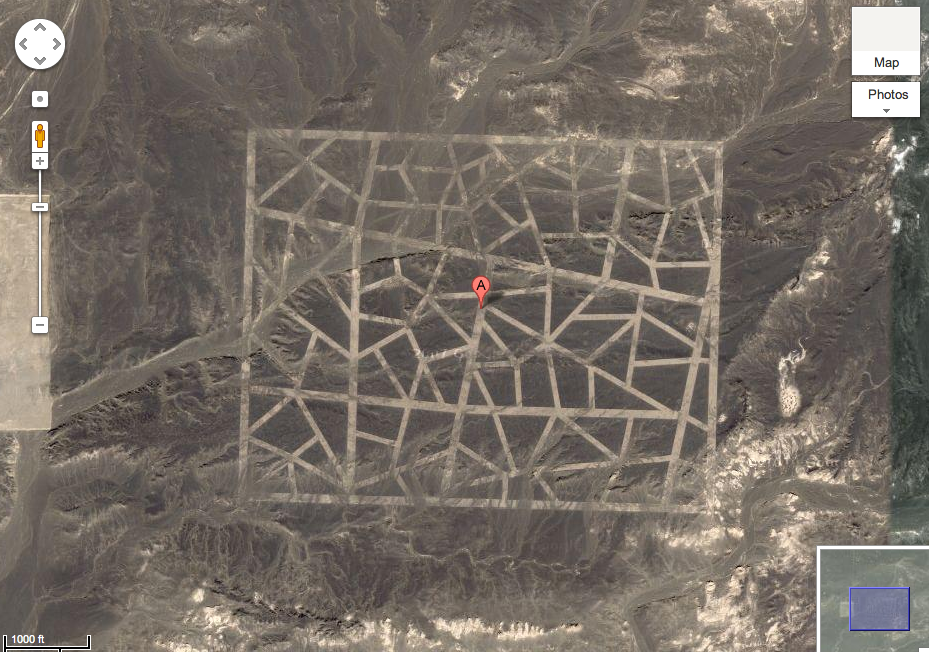
These pictures were found via Google Maps in China's Kumtag Desert. To read more on these mysterious structures:

Why Is China Building These Gigantic Structures In the Middle of the Desert?
Jesus Diaz
Nov 13, 2011
http://gizmodo.com/5859081/why-is-china-building-these-gigantic-structures-in-the-middle-of-the-desert

Chinese TV Host Says Regime Nearly Bankrupt
Matthew Robertson, Epoch Times
November 13, 2011
China’s economy has a reputation for being strong and prosperous, but according to a well-known Chinese television personality the country’s Gross Domestic Product is going in reverse.
Larry Lang, chair professor of Finance at the Chinese University of Hong Kong, said in a lecture that he didn’t think was being recorded that the Chinese regime is in a serious economic crisis—on the brink of bankruptcy. In his memorable formulation: every province in China is Greece.
The restrictions Lang placed on the Oct. 22 speech in Shenyang City, in northern China’s Liaoning Province, included no audio or video recording, and no media. He can be heard saying that people should not post his speech online, or “everyone will look bad,” in the audio that is now on Youtube.
In the unusual, closed-door lecture, Lang gave a frank analysis of the Chinese economy and the censorship that is placed on intellectuals and public figures. “What I’m about to say is all true. But under this system, we are not allowed to speak the truth,” he said.
Despite Lang’s polished appearance on his high-profile TV shows, he said: “Don’t think that we are living in a peaceful time now. Actually the media cannot report anything at all. Those of us who do TV shows are so miserable and frustrated, because we cannot do any programs. As long as something is related to the government, we cannot report about it.”
He said that the regime doesn’t listen to experts, and that Party officials are insufferably arrogant. “If you don’t agree with him, he thinks you are against him,” he said.
Lang’s assessment that the regime is bankrupt was based on five conjectures.
Firstly, that the regime’s debt sits at about 36 trillion yuan (US$5.68 trillion). This calculation is arrived at by adding up Chinese local government debt (between 16 trillion and 19.5 trillion yuan, or US$2.5 trillion and US$3 trillion), and the debt owed by state-owned enterprises (another 16 trillion, he said). But with interest of two trillion per year, he thinks things will unravel quickly.
Secondly, that the regime’s officially published inflation rate of 6.2 percent is fabricated. The real inflation rate is 16 percent, according to Lang.
Thirdly, that there is serious excess capacity in the economy, and that private consumption is only 30 percent of economic activity. Lang said that beginning this July, the Purchasing Managers Index, a measure of the manufacturing industry, plunged to a new low of 50.7. This is an indication, in his view, that China’s economy is in recession.
Fourthly, that the regime’s officially published GDP of 9 percent is also fabricated. According to Lang’s data, China’s GDP has decreased 10 percent. He said that the bloated figures come from the dramatic increase in infrastructure construction, including real estate development, railways, and highways each year (accounting for up to 70 percent of GDP in 2010).
Fifthly, that taxes are too high. Last year, the taxes on Chinese businesses (including direct and indirect taxes) were at 70 percent of earnings. The individual tax rate sits at 81.6 percent, Lang said.
Once the “economic tsunami” starts, the regime will lose credibility and China will become the poorest country in the world, Lang said...
Full Article:
http://www.theepochtimes.com/n2/china-news/chinese-tv-host-says-regime-nearly-bankrupt-141214.html
Gadhafi’s Gold-money Plan Would Have Devastated Dollar
Alex Newman Friday, 11 November 2011
http://thenewamerican.com/economy/markets-mainmenu-45/9743-gadhafis-gold-money-plan-would-have-devastated-dollar
It remains unclear exactly why or how the Gadhafi regime went from “a model” and an “important ally” to the next target for regime change in a period of just a few years. But after claims of “genocide” as the justification for NATO intervention were disputed by experts, several other theories have been floated.
Oil, of course, has been mentioned frequently — Libya is Africa‘s largest oil producer. But one possible reason in particular for Gadhafi’s fall from grace has gained significant traction among analysts and segments of the non-Western media: central banking and the global monetary system.
According to more than a few observers, Gadhafi’s plan to quit selling Libyan oil in U.S. dollars — demanding payment instead in gold-backed “dinars” (a single African currency made from gold) — was the real cause. The regime, sitting on massive amounts of gold, estimated at close to 150 tons, was also pushing other African and Middle Eastern governments to follow suit.
And it literally had the potential to bring down the dollar and the world monetary system by extension, according to analysts. French President Nicolas Sarkozy reportedly went so far as to call Libya a “threat” to the financial security of the world. The “Insiders” were apparently panicking over Gadhafi’s plan.
"Any move such as that would certainly not be welcomed by the power elite today, who are responsible for controlling the world's central banks,” noted financial analyst Anthony Wile, editor of the free market-oriented Daily Bell, in an interview with RT. “So yes, that would certainly be something that would cause his immediate dismissal and the need for other reasons to be brought forward [for] removing him from power."
According to Wile, Gadhafi’s plan would have strengthened the whole continent of Africa in the eyes of economists backing sound money — not to mention investors. But it would have been especially devastating for the U.S. economy, the American dollar, and particularly the elite in charge of the system.
“The central banking Ponzi scheme requires an ever-increasing base of demand and the immediate silencing of those who would threaten its existence,” Wile noted in a piece entitled “Gaddafi Planned Gold Dinar, Now Under Attack” earlier this year. “Perhaps that is what the hurry [was] in removing Gaddafi in particular and those who might have been sympathetic to his monetary idea.”
Investor newsletters and commentaries have been buzzing for months with speculation about the link between Gadhafi’s gold dinar and the NATO-backed overthrow of the Libyan regime. Conservative analysts pounced on the potential relationship, too.
“In 2009 — in his capacity as head of the African Union — Libya's Moammar Gadhafi had proposed that the economically crippled continent adopt the ‘Gold Dinar,’” noted Ilana Mercer in an August opinion piece for WorldNetDaily. “I do not know if Col. Gadhafi continued to agitate for ditching the dollar and adopting the Gold Dinar — or if the Agitator from Chicago got wind of Gadhafi's (uncharacteristic) sanity about things monetary.”
But if Arab and African nations had begun adopting a gold-backed currency, it would have had major repercussions for debt-laden Western governments that would be far more significant than the purported “democratic” uprisings sweeping the region this year. And it would have spelled big trouble for the elite who benefit from “freshly counterfeited funny-money,” Mercer pointed out.
“Had Gadhafi sparked a gold-driven monetary revolution, he would have done well for his own people, and for the world at large,” she concluded. “A Gadhafi-driven gold revolution would have, however, imperiled the positions of central bankers and their political and media power-brokers.”
Adding credence to the theory about why Gadhafi had to be overthrown, as The New American reported in March, was the rebels’ odd decision to create a central bank to replace Gadhafi’s state-owned monetary authority. The decision was broadcast to the world in the early weeks of the conflict.
In a statement describing a March 19 meeting, the rebel council announced, among other things, the creation of a new oil company. And more importantly: “Designation of the Central Bank of Benghazi as a monetary authority competent in monetary policies in Libya and appointment of a Governor to the Central Bank of Libya, with a temporary headquarters in Benghazi.”
The creation of a new central bank, even more so than the new national oil regime, left analysts scratching their heads. “I have never before heard of a central bank being created in just a matter of weeks out of a popular uprising,” noted Robert Wenzel in an analysis for the Economic Policy Journal. “This suggests we have a bit more than a rag tag bunch of rebels running around and that there are some pretty sophisticated influences,” he added. Wenzel also noted that the uprising looked like a “major oil and money play, with the true disaffected rebels being used as puppets and cover” while the transfer of control over money and oil supplies takes place.
Other analysts, even in the mainstream press, were equally shocked. “Is this the first time a revolutionary group has created a central bank while it is still in the midst of fighting the entrenched political power?” wondered CNBC senior editor John Carney. “It certainly seems to indicate how extraordinarily powerful central bankers have become in our era.”
Similar scenarios involving the global monetary system — based on the U.S. dollar as a global reserve currency, backed by the fact that oil is traded in American money — have also been associated with other targets of the U.S. government. Some analysts even say a pattern is developing.
Iran, for example, is one of the few nations left in the world with a state-owned central bank. And Iraqi despot Saddam Hussein, once armed by the U.S. government to make war on Iran, was threatening to start selling oil in currencies other than the dollar just prior to the Bush administration’s “regime change” mission.
While most of the establishment press in America has been silent on the issue of Gadhafi’s gold dinar scheme, in Russia, China, and the global alternative media, the theory has exploded in popularity. Whether salvaging central banking and the corrupt global monetary system were truly among the reasons for Gadhafi’s overthrow, however, may never be known for certain — at least not publicly.
Saturday, September 24, 2011
Why the kung-fu monks are losing their religion
The Buddhists of Shaolin gave the world its most deadly martial art. But now their gift has become a curse, writes Clifford Coonan
Monday, 12 September 2011
http://www.independent.co.uk/news/world/asia/why-the-kungfu-monks-are-losing-their-religion-2353184.html
Young men spring through the air, performing elegant punches and kicks; others bound across the dirt, swords flashing through the misty air. An ancient tree has dozens of small dents, made by "finger punches" of warrior monks over the centuries.
This is the Shaolin temple complex, in the mountains of central China, where kung fu was born 1,500 years ago. Now a place of pilgrimage for martial arts enthusiasts and Zen Buddhists, thousands of young people come to study kung fu, or wushu as it is known in China, in schools around the temple.
The commercial success of the temple is obvious, even if some of the sights are jarring – the telephone kiosks with Buddhas on top, for example. It has some monks shaking their heads and fearing that its spiritual peace is threatened. One monk said he was leaving after decades at the temple to be a hermit in the mountains of eastern China.
"There are internal conflicts here, and it's complicated. When I came here it was very shabby, and it has improved a lot. But I don't think this is a place for religion anymore," he says.
Many others are inspired by the Shaolin tradition. Kung fu is the epitome of martial arts, and practitioners say other fighting arts including karate originated from kung fu. There are more than a million learners of kung fu around the world and many centres of Shaolin culture globally.
For the 60,000 young would-be kung fu stars kicking and punching away at the schools around the temple, Shaolin kung fu offers a way out of poverty. Wu Zhiqiang, 17, comes from near the Henan capital of Zhengzhou. He has been in Shaolin for four years and is one of 4,000 students at his school. "I've been practising since 5am," he says, still brandishing a spear at lunchtime. "We practise outside in the morning, then study in the classroom. My aim is to go to physical education college in Zhengzhou. But some of my friends want to be coaches. And of course some of us want to be in the movies."
Kung fu owes its existence to an Indian monk, Bodhi Dharma, who began to preach Zen Buddhism in the temple and started its martial arts tradition. The Shaolin style was expanded over the years from 72 basic fighting movements to 170 moves, divided into five styles named after the animal that the movements were supposed to resemble: Tiger, Leopard, Snake, Dragon and Crane.
But has its popularity made it too commercial and and too disconnected from its roots? Qian Daliang, general manager of the Henan Shaolin Temple Development Company, said not. "Our aim is to protect Shaolin, and maintain the real Shaolin," he says. "We have a good name but people here and overseas use the name to make money and in some cases ruin the name of Shaolin. We have to protect ourselves, and our intellectual property." The temples' 228 brick pagodas survived the Cultural Revolution, when Red Guards marauded across China destroying religious sites. Their status as burial sites saved the 1,200-year-old Pagoda Forest, which has featured in many kung fu epics, and is part of what attracts the thousands of tourists to Shaolin. But they were not untainted by the Red Guard fervour. The monks in Shaolin were forced to drink alcohol and eat meat by the Red Guards. They remember this still, and they have a saying: "Alcohol and meat only pass through your digestive system, but Buddha is within."
Reform and the opening up in China has seen a revival in the temple's fortunes, thanks to the interest in martial arts movies during the 1970s. A building at the very back of the complex was used in The Shaolin Temple, in 1982, which featured Jet Li.
The latest, Shaolin, which features Hong Kong heartthrob Andy Lau and action hero Jackie Chan, is released on DVD today in Britain.
"Like many of my peers starting out in the film industry in the early 1980s, I was influenced and inspired by the original Shaolin Temple," says its director, Benny Chan. "I mean, wow, there was Jet Li executing the most perfect of 360-degree roundhouse kicks in mid-air. It was both stunning and riveting. Don't forget The Shaolin Temple was made before China opened up – it was such a rarity."
The abbot of the monastery, Shi Yongxin, a farmer's son from nearby Anhui, has been credited as the architect of Shaolin's revival since taking over in 1999. He is known for his business-minded approach to transforming the temple and promoting Buddhism throughout the world over the past two decades.
Since 1986, he has led Shaolin monk delegations across China and abroad to perform Shaolin martial arts shows, registering the trademark of the names "Shaolin" and "Shaolin Temple" in 1994.
He has also sparked controversy, demanding an official apology from an online commentator who dared to say its monks had once been beaten in unarmed combat by Japanese ninja warriors. He has also been criticised for accepting the gift of a luxury sports car from the authorities, and many monks did not like the decision to host its own martial arts reality TV show. But Mr Qian insists the temple needs its commercial activities to ensure its survival. "The Shaolin monastery has had its ups and downs. At one point there were over 2,000 monks here, but after the Cultural Revolution, there were only 15 monks left. But the spirit of Shaolin never stops, and that's what we are aiming to continuously deliver," said Mr Qian.
China & The "L" Word
From The London Telegraph:
A key rate setter-for China's central bank let slip – or was it a slip? – that Beijing aims to run down its portfolio of US debt as soon as safely possible.
"The incremental parts of our of our foreign reserve holdings should be invested in physical assets," said Li Daokui at the World Economic Forum in the very rainy city of Dalian – former Port Arthur from Russian colonial days.
"We would like to buy stakes in Boeing, Intel, and Apple, and maybe we should invest in these types of companies in a proactive way."
"Once the US Treasury market stabilizes we can liquidate more of our holdings of Treasuries," he said.
To my knowledge, this is the first time that a top adviser to China's central bank has uttered the word "liquidate". Until now the policy has been to diversify slowly by investing the fresh $200bn accumulated each quarter into other currencies and assets – chiefly AAA euro debt from Germany, France and the hard core.
We don't know how much US debt is held by SAFE (State Administration of Foreign Exchange), the bank's FX arm. The figure is thought to be over $2.2 trillion.
The Chinese are clearly vexed with Washington, viewing the Fed's QE as a stealth default on US debt. Mr Li came close to calling America a basket case, saying the picture is far worse than when Ronald Reagan and Margaret Thatcher took over in the early 1980s.
Mr Li, one of three outside academics on China's MPC, described the debt deals on Capitol Hill as "just trying to by time", saying it will not be enough to stop America's "debt dynamic" turning dangerous...
China to 'liquidate' US Treasuries, not dollars
Ambrose Evans-Pritchard Economics
September 15th, 2011
http://blogs.telegraph.co.uk/finance/ambroseevans-pritchard/100011987/china-to-liquidate-us-treasuries-not-dollars
Wednesday, June 22, 2011
This is a city built for a million people - but no one lives here

This is a city built for a million people - but no one lives here
The Mongolian metropolis thrust into the 21st Century in a storm of steel and concrete
Peter Hitchens
29th May 2011
http://www.dailymail.co.uk/news/article-1391868/This-city-built-million-people--lives-here.html
Modern China is like a great freight train storming up a long, steep slope with no summit in sight, all its locomotives straining. It cannot slow or stop. The brakes would never hold. If it pauses for a second, it will start to roll back towards disaster. The whole world would be shaken by the crash that followed.
So there is no joy in asking if China has outgrown its strength after ten years of blazing, enthralling growth. But it may have done so. The hedge-fund managers, those canny vultures of finance, are beginning to circle slowly, high overhead. They are starting to bet on the bursting of the Chinese bubble. These people did not become very rich indeed by guessing wrong.
And one of the reasons for their gloomy guesswork is here, in the strange, wistful landscape of Inner Mongolia, birthplace and home of Genghis Khan.
The journey here is full of the thrill and muscle of the new China. With its colossal proven coal reserves of 170 billion tons (about one sixth of China's entire coal reserve and enough to keep a normal country going for centuries), the Great Khan's land, once famous only for marauding armies and destruction, has become important in a new way.
As you get closer to its heart, you see many of the famous new coal-fired power stations that China is building at a rate of two a week. You see forests of shiny new electricity pylons. You see the enormous white concrete stilts of new motorways and express railways, penetrating what until now has been a lonely steppe of soft red earth, deep ravines and prehistoric hamlets of cave-like homes.
You also see the mountain ranges of newly mined coal that are being loaded into the incessant, unbelievably long, low, black trains that trundle in all directions, in cheerful mockery of the West's footling green campaigns.
As my train rolled into Dong Sheng, the main station for the Ordos urban area, a Chinese fellow traveller who had often visited Ordos in the past (and had promised to let me know when we arrived) failed to realise that this was our destination - because he no longer recognised the place. So many new buildings had gone up since he had last been there that until he saw the station sign he didn't know we had arrived.
Someone has obviously decided that Inner Mongolia is to be thrust into the 21st Century in a storm of steel and concrete. This will need people, who have previously been fairly rare in the violent climate and never-resting winds. And so they have built a great new city to draw them in. What would happen if nobody came to live in it? We may soon find out.
Seen from space, Kangbashi is a metropolis fit to hold a million busy, prosperous people, with sweeping boulevards, a spacious central square, homes, factories and offices spread over 12 square miles and a wide river running through it.
In its publicity, Kangbashi is a super-modern megalomaniac's dream. There is a sculpture park containing dozens of abstract figures in faintly obscene embraces, standing for the unity of the people and the Chinese armed forces.
The whims of modern architects have been indulged, with a drum-shaped concert hall that looks much like a sawn-off cooling tower, and a leaning library built to resemble a shelf of books - next to a sort of giant cowpat coated in reflective bronze, perhaps symbolising Inner Mongolia's dairy industry.
Seen from the new expressway which leads to it, it is a majestic line of towers in the haze. But at ground level there is something severely wrong. Traffic is slowed because a huge advertising hoarding has fallen from a bridge on to the carriageway. Like so much of modern China, sparkling at a distance, grubby and cracked close to, the reality does not quite live up to the appearance.
There is far worse to come. One approach road leads past what was until recently a 30,000-seater stadium, costing £100 million and rushed to completion in nine months for last year's Mongolian Games - horse-racing, archery and wrestling. When it was opened, it looked rather like Concorde about to take off. But soon after New Year's Day, a whole white wing, plus the central peak, collapsed during the night.
'Like so much of modern China, sparkling at a distance, grubby and cracked close to, the reality does not quite live up to the appearance' Thank Heaven, there was nobody in it at the time. The road to the ruin is closed but it is possible to hurry by and see the colossal wreck, the tangled steel now cleared away but the missing sections not yet rebuilt.
It is not wise to look too interested, as we shall see. Officials have, of course, denied that the collapse was the result of the hurry to finish in time for the Games.
They blame welding defects and the harsh weather (which was not exactly a surprise in this blizzard-blasted part of the world).
Peking is intensely sensitive about such so-called 'Tofu Projects' - hurried and grandiose building schemes, which can and do kill.
Artist and dissident Ai Weiwei has been 'disappeared' by this sinister police state, partly because he made it his business to investigate and expose the corrupt skimping of work, the sub-standard reinforcement and poor-quality materials that led to the deaths of thousands of schoolchildren when their classrooms were shaken into rubble by the 2008 earthquake, which measured eight on the Richter scale, in Sichuan. Japanese schools withstood a far greater earthquake this year.
In 2007 the new 360-yard Tuojiang Bridge in Hunan fell apart as workers removed its scaffolding.
These are just the ones we have heard about. Who knows how many other disasters or near-disasters have gone unrecorded?
This is anything but a free country. A Chinese journalist who tried to take photographs of the wreckage outside Kangbashi, was detained and 'asked' to hand over his pictures. As far as I can find out, there are no surviving photographs of the scene immediately after the building fell. Orders from on high saw to that.
For it is from on high that instructions came to encourage local business to invest in this place, which previously contained two insignificant villages with about 1,500 people in them. And it is from on high that the will and force come, which have created a city out of nothing on the empty steppe.
This was the deal, binding Communist Party, state, military and businessmen. The local government would build the roads, the schools and the infrastructure. The investors would bring the car factory (now working), the business headquarters and the rest. The police and the army would occupy major buildings.
Together, they planned to spend £1.7 billion on the theory that, if you build it, they will come. Wealthy Chinese would buy the apartments and the place would soon fill with people.
Not so far. In the middle of the afternoon, it is possible to get killed by the typically callous Chinese traffic, but only if you make a major effort to do so. Traffic is so thin on Genghis Khan Square that a pedestrian can hope to cross the 50-yard wide boulevard without waiting for the lights, provided he keeps his wits about him. This is not the case in any other Chinese city I have ever visited.
Past the monstrous sculpture of Genghis Khan and his friends stand two great rearing sculpted horses (Mongolia's national symbol, though the real thing is quite rare here). A notice on the more-or-less bare earth beneath them orders citizens to keep off the non-existent grass, and when I ignore this instruction, an official (apparently posted for this purpose) spots me from about a quarter of a mile away and starts shouting angrily. He must have to wait hours for each opportunity to do this, as visitors are almost as sparse as the precious grass.
Between the horses is a far vista of unfinished blocks of flats, staring out over the landscaped riverbank and a large ornamental park dedicated to Genghis Khan's mother, and presided over by a 50ft statue of this no doubt impressive lady.
All the glassless windows and raw concrete (plus the extravagant monuments and the feeling that everyone has gone away) remind me strongly of the North Korean capital of Pyongyang, which is brooded over by the stupendous unfinished Ryugyong Hotel. This is another place where ambition far outstrips reality.
Many of the hundreds of building sites are wholly silent, or are barely active, with one or two workers visible among the cranes and hoists. But there are advantages to being a pioneer in such a place, as well as drawbacks.
Among customers in a small grocery shop, where the prices of fruit and meat are startling high, there is only praise for the high quality of the teaching at the Number One High School.
This is a prestige project, a fenced off campus the size of a small university with dining hall, gymnasium and, unusually, large blocks for weekly boarders - children from Dong Sheng 15 miles away, who have been moved here to inject life and youth into what would otherwise be a near-empty building.
The excellent teachers have been lured here with extra-high salaries, so the children get a better education in return for being away from home for much of the year. The place is plainly still less than halffull, the staff car park almost empty, the pupils' bicycle racks not much fuller.
Others complain about speculators who are said to be buying up the apartments in the hope that one day the city will boom, so making them more expensive than they need to be.
One man purchasing meat says that the city's population has doubled in the past year - but nobody is sure what the true figure might be. Some say it is as high as 150,000, but judging by the light traffic, the many darkened windows at night and the small number of cars parked outside new housing in the evening, I would be surprised if it was anything like that large.
Yet who knows? It might work. The first supermarkets are starting to open. Spacious buses cruise the avenues, in contrast to most of China where public transport is a sweaty and claustrophobic squeeze.
There is always somewhere to park. There are cheap restaurants - and costlier ones. The main hotel is already hosting elaborate wedding parties. But this activity may be largely artificial, as the police and several mysterious parts of the People's Liberation Army have set up large offices here (presumably on government orders) and so give the place an air of being busier than it truly is.
The previous day I had seen a vision of what might happen if Kangbashi fails. The new city of Quingshuihe, near Clearwater River, is far smaller than the giant Kangbashi.
And it is certainly needed, as the old town is a horrible, cramped dump of miserable concrete blocks huddled around roads that barely deserve their name, petering out quickly into mud and potholes.
It is so wretched that it is officially classified as impoverished, and is in many ways more like Africa than modern urban China. Yet this is only two hours' bumpy drive from the provincial capital of Hohhot, with its grandiose city centre and plentiful neon and concrete.
But here, unlike in Kangbashi, the new town is almost completely untenanted (apart from the police and a few municipal officials).
The rise of China, a crude police state inherited from communist rule by greedy, corrupt cynics who appear to believe in nothing, was a shocking break with all that we had knownOn one side of a road as wide as a runway, down which a powerful wind sweeps dust and litter, are what might have been meant to be a hotel, and what might have been meant to be flats - both of them utterly abandoned with a concrete mixer fallen from its stand and lying like a dead Martian in the rubble-heaped front yard.
Some way from the rest of the aborted, futile township is an entire courthouse, surrounded by scrub and rough earth, its flagpoles empty, its crumbling steps adorned with stylised stone lions and its top storeys adorned with the (slightly uneven looking) scales of Chinese justice. But ghostliest and bleakest of all is an unused prison, watchtowers and all, waiting for convicts whose crimes will never be committed - because the place where they would have happened has never had any people in it.
When I first saw the new Shanghai more than seven years ago I was alarmed by the explosive power I saw - but even more by what it meant. The rise of China, a crude police state inherited from communist rule by greedy, corrupt cynics who appear to believe in nothing, was a shocking break with all that we had known.
It meant that the link between liberty and prosperity, which we had assumed throughout the Cold War was unbreakable, was gone. From now on, the world could get rich without being free.
Later I would see much more of China's majesty, power and squalor - the cruel treatment of the poor who wish to defy the one-child policy; the dismal sweatshops that produce so much of what we buy, all unaware of the sad places where it is made; the horrible massacre of unborn baby girls in this fiercely male-dominated culture; the filthy pollution that goes unchecked; the bullying and suppression of minority peoples by increasingly nationalist Chinese; the cynical corruption and greed of China's colonial enterprise in Africa; the crude destruction of historical treasures that do not suit the regime - and all of this against a background of apparently unstoppable energy and hard work, of freemarket economics made visible.
Did I wish it well or ill? I was never sure, and China does not much care what we think of her anyway.
But we have to care about China whether we want to or not. The United States is hopelessly in debt to her. The world economy is largely kept moving by her. If the hedge-fund vultures are right, the great Chinese train is about to slide back down the slope it has climbed.
Its credit levels are said to be unsustainable. It produces far more steel and far more cement than it can use - amazing statistics given its hunger for both. House prices are far too high.
Banks, like ours, have lent money against land that is unlikely to hold its value. With millions of properties empty, it continues to build more.
I am forced to hope that there is no Chinese bubble, that the frantic growth will continue, that the steel and the cement are sold and used, that the properties are occupied, that Kangbashi flourishes.
Because if not, I fear the resulting economic and political desolation there - and here - will make the days of Genghis Khan seem tame.
Subscribe to:
Posts (Atom)

 Posts


