
Showing posts with label Steven Spielberg. Show all posts
Showing posts with label Steven Spielberg. Show all posts
Sunday, January 20, 2013
What 'Lincoln' misses and another film gets right
What 'Lincoln' misses and another Civil War film gets right
John Blake
Tue January 8, 2013
http://www.cnn.com/2013/01/08/showbiz/slavery-pbs/index.html
(CNN) -- He used the N-word and told racist jokes. He once said African-Americans were inferior to whites. He proposed ending slavery by shipping willing slaves back to Africa.
Meet Abraham Lincoln, "The Great Emancipator" who "freed" the slaves.
That's not the version of Lincoln we get from Steven Spielberg's movie "Lincoln." But there's another film that fills in the historical gaps left by Spielberg and challenges conventional wisdom about Lincoln and the Civil War.
"The Abolitionists" is a PBS American Experience film premièring Tuesday that focuses on the intertwined lives of five abolitionist leaders. These men and women arguably did as much -- maybe even more -- than Lincoln to end slavery, yet few contemporary Americans recognize their names.
The three-part documentary's airing comes as the nation commemorates the 150th anniversary of the Emancipation Proclamation, the 1863 decree signed by Lincoln that set in motion the freeing of slaves. Lincoln is a Mount Rushmore figure today, but the abolitionists also did something remarkable. They took on the colossal wealth and political power of the slave trade, and won. (Imagine activists today persuading the country to shut down Apple and Google because they deem their business practices immoral.)
The abolitionists "forced the issue of slavery on to the national agenda," says Sharon Grimberg, executive producer for the PBS documentary. "They made it unavoidable."
"The Abolitionists" offers four surprising revelations about how the abolitionists triumphed, and how they pioneered many of the same tactics protest movements use today.
No. 1: The Great Persuader was not Lincoln
Near the end of "Lincoln," Spielberg shows the president delivering his second inaugural address, a majestic speech marked by harsh biblical language. Lincoln is often considered to be the nation's greatest president in part because of such speeches. He was an extraordinary writer.
But the most well-known condemnation of slavery during that era didn't come from the pen of Lincoln. It came from the pen of Harriet Beecher Stowe, the daughter of a Presbyterian minister who joined the abolitionist movement, the PBS film says.
Stowe's "Uncle Tom's Cabin" awakened the nation to the horrors of slavery more than any other speech or book of that era, some historians say. It hit the American public like a meteor when it was published in 1852. Some historians say it started the Civil War.
The novel revolved around a slave called Tom, who attempted to preserve his faith and family amid the brutality of slavery. The book became a massive best-seller and was turned into a popular play. Even people who cared nothing about slavery became furious when they read or saw "Uncle Tom's Cabin"' performed on stage, the documentary reveals.
The lesson: Appeal to people's emotion, not their rationale, when trying to rally public opinion.
Abolitionists had tried to rouse the conscience of Americans for years by appealing to their Christian and Democratic sensibilities. They largely failed. But Stowe's novel did something all those speeches didn't do. It told a story. She transformed slaves into sympathetic human beings who were pious, courageous and loved their children and spouses.
"When abolitionists were talking about the Constitution and big ideas about freedom and liberty, that's abstract," says R. Blakeslee Gilpin, a University of South Carolina history professor featured in "The Abolitionists."
"But Stowe begins with the human dimension. She shows the human victims from the institution of slavery."
150 years later, myths persist about the Emancipation Proclamation
No. 2: It's the economy, stupid
Want to know why slavery lasted so long? The simplistic answer: racism. Another huge factor: greed, according to "The Abolitionists."
Many abolitionists didn't realize this when they launched the anti-slavery movement, the documentary shows. They were motivated by Christian idealism, but it was no match for the power of money.
Christianity and slavery were two of the big growth industries in early America. The country underwent two "Great Awakenings" in the early 19th century -- while slavery continued to spread.
But the spread of Christianity did little to stop the spread of slavery because too many Americans made money off slavery, the documentary shows. The wealth produced by slavery transformed the United States from an economic backwater into an economic and military dynamo, says Gilpin, also author of "John Brown Still Lives!: America's Long Reckoning With Violence, Equality, and Change."
"All the combined economic value of industry, land and banking did not equal the value of humans held as property in the South," Gilpin says.
Many Americans hated abolitionists because they saw them as a threat to prosperity, says David Blight, a Yale University historian featured in "The Abolitionists."
"They wondered if you really did destroy slavery, where would all of these black people go, and whose jobs would they take," says Blight.
The South wasn't the only region that profited off the slave trade. Abolitionists faced some of their most vicious opposition in the North. New York City, for example, was a pro-slavery town because it was filled with bankers and cotton merchants who benefited from slavery, Blight says.
"Jim Crow laws did not originate in the South; they originated in the North," Blight says.
The lesson: Don't reduce the issue of slavery to racism. Follow the money.
No. 3: Flawed reformers
The historian Henry Louis Gates Jr. once said that black abolitionists used to say that the only thing white abolitionists hated more than slavery was the slave.
"The Abolitionists" reveals that some of the most courageous anti-slavery activists were infected with the same white supremacist attitudes they crusaded against. White supremacy was so ingrained in early America that very few escaped its taint, even the most noble.
The documentary shows how racial tensions destroyed the friendship between two of the most famous abolitionists: Frederick Douglass and William Lloyd Garrison. Garrison was the editor of an abolitionist newspaper who convinced Douglass that he could be a leading spokesman against the institution that once held him captive.
Erica Armstrong Dunbar, a history professor featured in the film, says some abolitionists were uncomfortable with interracial relationships. They wouldn't walk with black acquaintances in public during the day, and refused to sit with them in church.
Lesson: Racism was so embedded in 19th century America that even those who fought against racism were unaware that it still had a hold on them.
"The majority of aboloitionists did not believe in civic equality for blacks," Dunbar says. "They believed the institution of slavery was immoral, but questions about whether blacks were equal, let alone deserved the right to vote, were an entirely different subject."
No. 4: Lincoln the "recovering racist"
Tell some historians that "Lincoln freed the slaves" and one can virtually see the smoke come out of their ears.
"Please don't get me started," Dunbar says after hearing that phrase.
"There's this perception that good old Lincoln and a few others gave freedom to black people. The real story is that black people and people like Douglass wrestled their freedom away," Dunbar says.
Historians still argue over Lincoln's racial attitudes. The historian Henry Louis Gates Jr. once called him a "recovering racist" who used the N-word and liked black minstrel shows.
Others point to the public comments Lincoln made during one of his famed senatorial debates with Stephen Douglas in 1858 when he said, "There is a physical difference between the white and black races which I believe will forever forbid the two races living together on terms of social and political equality.
"There must be the position of superior and inferior, and I as much as any other man am in favor of having the superior position assigned to the white race," Lincoln said in the speech.
Spielberg's film depicts Lincoln as a resolute opponent of slavery, willing to deploy all the powers of his office to destroy it.
Yet "The Abolitionists" paints another portrait of Lincoln. It recounts how he supported colonization plans to ship willing slaves back to Africa. It says that Lincoln once floated a peace treaty offer to the Confederates that would allow them to keep slaves until 1900 if they surrendered. At one White House meeting with black ministers, Lincoln virtually blamed slaves for starting the war, the film's narrator says.
Blight, the Yale University historian, says Lincoln always personally hated slavery. He publicly spoke out against it as early as the 1840s, and spoke often about stopping the expansion of slavery.
Lincoln hoped to slowly end slavery without tearing the nation apart, Blight says.
"He was a gradualist," Blight says. "He was trying to prevent a bloody revolution over it. He couldn't."
He couldn't because of the pressure exerted by the abolitionists and the slaves themselves, other historians say. Blacks did not wait for white people to free them, they say. At least 180,000 blacks fought in the Civil War. And Douglass was one of Lincoln's harshest critics. He constantly pushed Lincoln to move aggressively against slavery.
The historian William Jelani Cobb wrote in a recent New Yorker essay on slavery:
"On the hundred-and-fiftieth anniversary of the Emancipation Proclamation, it's worth recalling that slavery was made unsustainable largely through the efforts of those who were enslaved. The record is replete with enslaved blacks—even so-called house slaves—who poisoned slaveholders, destroyed crops, 'accidentally' burned down buildings."
As for Lincoln's true feelings about blacks, that matter may always be subject to debate.
"No historian would doubt that Lincoln was a man of his times," says Dunbar, author of "A Fragile Freedom: African American Women and Emancipation in the Antebellum City." "He was a racist, and never truly believed that blacks could live in America after emancipation."
Other historians say Lincoln was evolving into the leader that Spielberg depicts.
The historian Gates once wrote that Lincoln initially opposed slavery because it was an economic institution that discriminated against white men who couldn't afford slaves. Two things changed him: The courage black troops displayed in the Civil War and his friendship with Douglass the abolitionist.
"Lincoln met with Douglass at the White House three times. He was the first black person Lincoln treated as an intellectual equal, and he grew to admire him and value his opinion," Gates wrote.
Gilpin says Lincoln was great not only for what he got right, but because he could admit what he got wrong.
"You dream of a president like that," Gilpin says. "Not only was he a brilliant manipulator and reader of public opinion, but he had the capacity for growth. He came into office because he was a moderate but he turns out to be the Great Emancipator."
Lesson: Lincoln led an epic battle against slavery, but the abolitionists lit the fuse.

Wednesday, October 13, 2010
Scenic Routes: Jaws
http://www.avclub.com/articles/jaws,45876/
Scenic Routes
Jaws
Mike D'Angelo
October 4, 2010
A few years ago, Danish filmmakers Lars von Trier and Jørgen Leth co-directed a movie called The Five Obstructions, in which the former challenged the latter to remake his 1967 short “The Perfect Human” over and over again, subject to various arbitrary restrictions. (Example: No shot can last longer than 12 frames, or half a second.) The movie’s thesis—argued more convincingly in some segments than others, but hard to deny overall—is that limited options actually enhance rather than stifle creativity, mostly by forcing the director (or writer, or architect, or head coach) to come up with unusual solutions to difficult problems. Allowed to do anything they like, most people, no matter how talented, tend to fall back on whatever’s worked in the past, frequently with tepid or tedious results. Yanking some expected support out from under them, however much panic that instills, may well be doing them a big favor.
Steven Spielberg arguably had only one obstruction to deal with when he was making Jaws, but it was a doozy: His movie was about a killer shark, but the mechanical sharks he had built almost never worked. So he had to figure out some novel, visually compelling way to suggest many of the attacks, as he lacked the means to properly depict them. By all accounts, this setback seemed like a death knell to everybody on the set, Spielberg in particular. And yet it’s entirely possible that Jaws wouldn’t have become the phenomenon it did had it featured a fully functional Bruce The Shark, as the “compromised” film we have boasts a nearly perfect, nerve-jangling ratio of the in-your-face to the not-quite-seen. Tops in the latter category, in my opinion, is Bruce’s first open buffet at the fully crowded Amity beach, as supremely anxious Amity police chief Roy Scheider sees his worst nightmare come true.
Watching this scene for the first time in a bunch of years, I was struck by how elegantly it’s constructed, especially compared to today’s summer event movies. (Granted, there was no such thing as a “summer event movie” in 1975. Jaws almost single-handedly created that genre.) Spielberg immediately sets up the victims (and fake victims)—first following the fat woman into the water, then reversing direction to track along with the boy in the red trunks as he clambers back onto the beach, asking permission to get his inflatable raft. Now we know what the kid’s mom looks like, her memorable floppy hat included. That accomplished, Spielberg has the boy take us to Scheider, who appears in profile in the foreground, looking screen left, just as the kid disappears at screen right. In addition to which, the kid’s path along the beach horizontally bisects Scheider and a family reclining a few feet away, setting up the moment a bit later when the dad hits up Scheider for some municipal favor, blocking Scheider’s view of the ocean in the process. Then the dog. Then the floppy hat—hi, Mom. Then the boy hitting the surf on his raft. Back to the dog. Fat lady floating. Raft. Dog. More dog. Scheider.
And now comes one of the most subtly stunning effects in Spielberg’s entire oeuvre—way more effective, I think, than the much-celebrated dolly zoom when the shark strikes. (I will get to that.) In three successive shots, we move closer and closer to Scheider’s alert but still quasi-relaxed form, but with both cuts carefully disguised by the blurred motion of a random passerby. This creates the uncanny sensation that Scheider has somehow willed himself into greater and greater prominence in the frame, just by the sheer force of his unblinking hyper-vigilance. To his credit, Scheider doesn’t attempt to sell this moment at all. He lets the camera do all the work; nonetheless, viewers immediately project the sequence’s formal quality—which amounts to a sort of hidden jitteriness—onto the character’s mindset. Did Spielberg cook this up because he was aware that there wasn’t gonna be a whole lot happening in the water a few minutes later? No way to know for sure, but good luck finding any similar moments in, oh, say, Jurassic Park.
After some additional expert tension-building, we get our first indirect evidence of Bruce’s presence, in the form of the dog’s owner fruitlessly calling its name, and a shot of the stick the dog had been fetching floating sadly on the waves. Though it screws with my argument for this piece, I gotta admit that Spielberg’s decision not to show the dog become shark chow probably didn’t have much to do with mechanical failure. More likely, somebody felt like that would just be too much, as American cinema has a long, kind of ridiculous history of shying away from any overt depiction of domestic animals being killed—even in movies, like this one, that are totally willing to show giant arterial geysers spurting from innocent children. (To be fair, I believe Spielberg does have a dinosaur eat a dog in The Lost World.)
In any case, if the missing mutt didn’t clue us in that lunch will now be served and lunch is us, John Williams’ legendary duh-duh duh-duh now arrives to make it official. We get a long underwater shot of yummy kicking limbs, presumably from Bruce’s point of view, culminating in a view of the little boy’s raft overhead. When the attack finally commences, however, time it. It lasts 10 seconds. That’s it. You barely see the shark at all—even after watching the first shot of the kid being grabbed a dozen times, I’m still not sure whether I’m seeing fins or just corners of the raft flailing about. (Might be clearer on the big screen; I’m watching on an iMac.) There’s one horrible bloody instant, and then he’s just gone. Which is probably quite close to how such an attack would appear to observers in real life. Instantaneous absence. We’re left with Mom in her floppy hat, gradually realizing by process of elimination—well, and the raft with a hole chewed through the center—that she’s the big loser in today’s Shark Lotto.
As for the dolly zoom into Scheider at the moment of the attack, I don’t mean to hate. It just feels a bit gimmicky compared to the earlier invisible-zoom approach, which doesn’t get talked about nearly as much. On the other hand, one could argue that subtlety isn’t necessarily called for when you’ve just seen one of the citizens you’ve been hired to protect devoured whole. And again, I’m impressed by how Scheider underplays the moment. Most actors would feel compelled to signal their mounting horror, but he seems to understand that if the background is radically changing size while you remain constant (for those who don’t know, this is achieved by simultaneously zooming in and dollying back, or vice versa), that’s gonna be plenty charged enough—no need to help out via widening eyes or slackening jaw. All Scheider does (I think) is lean slightly forward right at the end, which more than suffices. We can manage the rest.
That said, I’m surprised nobody has yet created a YouTube parody in which the dolly zoom is portrayed as Scheider’s reaction to the truly frightening man-boobs on the elderly dude in the bathing cap. Giant and droopy is one (revolting) thing; tiny and round is just creepy as hell.
Scenic Routes
Jaws
Mike D'Angelo
October 4, 2010
A few years ago, Danish filmmakers Lars von Trier and Jørgen Leth co-directed a movie called The Five Obstructions, in which the former challenged the latter to remake his 1967 short “The Perfect Human” over and over again, subject to various arbitrary restrictions. (Example: No shot can last longer than 12 frames, or half a second.) The movie’s thesis—argued more convincingly in some segments than others, but hard to deny overall—is that limited options actually enhance rather than stifle creativity, mostly by forcing the director (or writer, or architect, or head coach) to come up with unusual solutions to difficult problems. Allowed to do anything they like, most people, no matter how talented, tend to fall back on whatever’s worked in the past, frequently with tepid or tedious results. Yanking some expected support out from under them, however much panic that instills, may well be doing them a big favor.
Steven Spielberg arguably had only one obstruction to deal with when he was making Jaws, but it was a doozy: His movie was about a killer shark, but the mechanical sharks he had built almost never worked. So he had to figure out some novel, visually compelling way to suggest many of the attacks, as he lacked the means to properly depict them. By all accounts, this setback seemed like a death knell to everybody on the set, Spielberg in particular. And yet it’s entirely possible that Jaws wouldn’t have become the phenomenon it did had it featured a fully functional Bruce The Shark, as the “compromised” film we have boasts a nearly perfect, nerve-jangling ratio of the in-your-face to the not-quite-seen. Tops in the latter category, in my opinion, is Bruce’s first open buffet at the fully crowded Amity beach, as supremely anxious Amity police chief Roy Scheider sees his worst nightmare come true.
Watching this scene for the first time in a bunch of years, I was struck by how elegantly it’s constructed, especially compared to today’s summer event movies. (Granted, there was no such thing as a “summer event movie” in 1975. Jaws almost single-handedly created that genre.) Spielberg immediately sets up the victims (and fake victims)—first following the fat woman into the water, then reversing direction to track along with the boy in the red trunks as he clambers back onto the beach, asking permission to get his inflatable raft. Now we know what the kid’s mom looks like, her memorable floppy hat included. That accomplished, Spielberg has the boy take us to Scheider, who appears in profile in the foreground, looking screen left, just as the kid disappears at screen right. In addition to which, the kid’s path along the beach horizontally bisects Scheider and a family reclining a few feet away, setting up the moment a bit later when the dad hits up Scheider for some municipal favor, blocking Scheider’s view of the ocean in the process. Then the dog. Then the floppy hat—hi, Mom. Then the boy hitting the surf on his raft. Back to the dog. Fat lady floating. Raft. Dog. More dog. Scheider.
And now comes one of the most subtly stunning effects in Spielberg’s entire oeuvre—way more effective, I think, than the much-celebrated dolly zoom when the shark strikes. (I will get to that.) In three successive shots, we move closer and closer to Scheider’s alert but still quasi-relaxed form, but with both cuts carefully disguised by the blurred motion of a random passerby. This creates the uncanny sensation that Scheider has somehow willed himself into greater and greater prominence in the frame, just by the sheer force of his unblinking hyper-vigilance. To his credit, Scheider doesn’t attempt to sell this moment at all. He lets the camera do all the work; nonetheless, viewers immediately project the sequence’s formal quality—which amounts to a sort of hidden jitteriness—onto the character’s mindset. Did Spielberg cook this up because he was aware that there wasn’t gonna be a whole lot happening in the water a few minutes later? No way to know for sure, but good luck finding any similar moments in, oh, say, Jurassic Park.
After some additional expert tension-building, we get our first indirect evidence of Bruce’s presence, in the form of the dog’s owner fruitlessly calling its name, and a shot of the stick the dog had been fetching floating sadly on the waves. Though it screws with my argument for this piece, I gotta admit that Spielberg’s decision not to show the dog become shark chow probably didn’t have much to do with mechanical failure. More likely, somebody felt like that would just be too much, as American cinema has a long, kind of ridiculous history of shying away from any overt depiction of domestic animals being killed—even in movies, like this one, that are totally willing to show giant arterial geysers spurting from innocent children. (To be fair, I believe Spielberg does have a dinosaur eat a dog in The Lost World.)
In any case, if the missing mutt didn’t clue us in that lunch will now be served and lunch is us, John Williams’ legendary duh-duh duh-duh now arrives to make it official. We get a long underwater shot of yummy kicking limbs, presumably from Bruce’s point of view, culminating in a view of the little boy’s raft overhead. When the attack finally commences, however, time it. It lasts 10 seconds. That’s it. You barely see the shark at all—even after watching the first shot of the kid being grabbed a dozen times, I’m still not sure whether I’m seeing fins or just corners of the raft flailing about. (Might be clearer on the big screen; I’m watching on an iMac.) There’s one horrible bloody instant, and then he’s just gone. Which is probably quite close to how such an attack would appear to observers in real life. Instantaneous absence. We’re left with Mom in her floppy hat, gradually realizing by process of elimination—well, and the raft with a hole chewed through the center—that she’s the big loser in today’s Shark Lotto.
As for the dolly zoom into Scheider at the moment of the attack, I don’t mean to hate. It just feels a bit gimmicky compared to the earlier invisible-zoom approach, which doesn’t get talked about nearly as much. On the other hand, one could argue that subtlety isn’t necessarily called for when you’ve just seen one of the citizens you’ve been hired to protect devoured whole. And again, I’m impressed by how Scheider underplays the moment. Most actors would feel compelled to signal their mounting horror, but he seems to understand that if the background is radically changing size while you remain constant (for those who don’t know, this is achieved by simultaneously zooming in and dollying back, or vice versa), that’s gonna be plenty charged enough—no need to help out via widening eyes or slackening jaw. All Scheider does (I think) is lean slightly forward right at the end, which more than suffices. We can manage the rest.
That said, I’m surprised nobody has yet created a YouTube parody in which the dolly zoom is portrayed as Scheider’s reaction to the truly frightening man-boobs on the elderly dude in the bathing cap. Giant and droopy is one (revolting) thing; tiny and round is just creepy as hell.
Friday, October 8, 2010
Taliban pulled from 'Medal of Honor' multiplayer mode

http://www.usatoday.com/tech/gaming/2010-10-01-medal-honor_N.htm
Taliban pulled from 'Medal of Honor' multiplayer mode
Mike Snider, USA TODAY
10-1-10
Video game publisher Electronic Arts is pulling a controversial feature that would have let players join the Taliban from Medal of Honor, one of the most anticipated releases of the year.
A popular franchise launched by Steven Spielberg a decade ago, Medal of Honor until now had played out in World War II. But this new entry (Oct. 12; for PS3 3, Xbox 360 and Windows PCs, $60, ages 17-up) is set in modern-day Afghanistan, pitting U.S. forces against al-Qaeda and Taliban fighters.
As originally planned, players in virtual battle online could team up in squads, one side of insurgents designated as the Taliban, with U.S. troops as their target. After rising criticism — including a sales ban in Army and Air Force exchange outlets — EA decided to change the game.
To be sensitive to families and friends of fallen soldiers, the game will be changed so that the "Opposing Force" or "OpFor" — not "Taliban" — will be in the multiplayer mode, says the game's executive producer Greg Goodrich. "Medal of Honor is a big thank-you letter to the troops, and if this one word caused some troops to not be able to receive that ... let's change it and hopefully people will get that."
Combat and war have been video game staples since the beginning. Early Atari arcade game Tank from 1974 led to Combat, a collection of battle games for the Atari 2600 console system.
As the graphic realism in games has evolved, so have the faces of the enemy. While past shooting games have focused on Nazis and monsters, newer games have pitted players against the Viet Cong and terrorists. For the more recent Call of Duty: Modern Warfare games, the developers invented fictional Middle Eastern protagonists.
What Medal of Honor attempted to do, says David Stone, director of the Institute for Military History & 20th Century Studies at Kansas State University, "seems to me, really is something new and different."
Other recent attempts to enlist video games in current Middle Eastern conflicts have met with resistance. After the U.S. invaded Iraq in 2003, Sony trademarked the phrase "Shock and Awe" for possible game use — a move met with criticism; it has since been abandoned. Last year, Konami dropped plans for Six Days in Fallujah, a game to be created with the help of Marine veterans of the Iraq war, just a month after announcing the project.
As they have become entrenched as a popular form of entertainment, games bear a deeper responsibility — for better or worse. "If games are indeed an art form or something like a play that people participate in," Stone says, "then we can legitimately ask what the intended message of that art is and what the artists want to say to us."
Thursday, June 10, 2010
Hunting Bruce, Or, On The Trail Of The 'Jaws' Shark

http://www.npr.org/templates/story/story.php?storyId=127370664
Hunting Bruce, Or, On The Trail Of The 'Jaws' Shark
by Cory Turner
June 2, 2010
Thirty-five years ago this month, one word was on the minds — and lips — of American moviegoers: "Shark!"
On June 20, 1975, Steven Spielberg's Jaws opened in theaters across the country. It starred Roy Scheider, Richard Dreyfuss, Robert Shaw and a newcomer to the screen: Bruce the mechanical shark. The film was both a commercial and critical success, claiming record box-office grosses (until it was eclipsed two years later by Star Wars) and earning several Oscars as well as a Best Picture nomination.
Bruce itself became a cultural icon — more than the sum of its elastomer skin and pneumatic parts — and gave the beach jitters to generations of Americans. Including me, once I finally saw it — Jaws terrified me so much as a kid that one important fact didn't immediately occur to me: The shark was fake.
Then I found a photo of Bruce being built, a workman leaning harmlessly into its mouth. That was my Heart of Darkness moment. At 10 years old, I decided that (a) I had to see Bruce for myself and (b) I had to touch it. Why? Simple: How dangerous is a shark you can touch?
There was just one problem: I couldn't persuade my parents to take part in a pilgrimage to one of the two places I thought Bruce might be: Los Angeles, where it was built, or Martha's Vineyard, where the film was shot. So I had to wait — until this spring. But I'm getting ahead of myself.
A Few Facts, And Certain Bits Of Back Story, About Bruce
Let's start with the name. It came from director Steven Spielberg — or rather from Spielberg's lawyer, Bruce Ramer.
The shark itself was every bit as big in real life as it's described as being in the film. So when marine biologist Matt Hooper (Richard Dreyfuss) exclaims, upon first seeing the shark, that it's a 20-footer, and Robert Shaw's Quint the shark hunter corrects him, saying it's 25, Quint's right.
The film's art director, Joe Alves, was hired to create the shark, and he remembers very clearly how he decided on those 25 feet. He made two life-size paper drawings of Bruce — one 20 feet long, the other 30 feet. He took the two to a parking garage on the Universal Studios back lot and put them side by side for studio executives. In a classic Goldilocks moment, the bigger shark seemed too big and the little shark too little. So Alves took the middle road.
Thirty years later, Jeff Pirtle, NBC Universal's manager of archives and collections, invited me to his office on the Universal Studios lot and showed me a number of Alves' original schematics for the shark. The width of those famous jaws: nearly 5 feet. The head alone, according to one schematic, weighed 400 pounds.
And the most important number of all: three. There were three Bruces, not one, created for the original Jaws.
All three sharks were created from the same mold. One was pulled by boat, when it had to swim convincingly on camera. The other two sat atop a metal arm, hidden underwater so they could, among other things, vault onto the deck of the Orca and make short work of Robert Shaw.
And while you wouldn't know it from watching the film, Bruce the mechanical shark had a dirty little secret: It didn't work very well. Stories abound of the animatronic shark stalling the moment it hit water and sinking to the seafloor. In fact, the finicky mechanics ended up pushing the film both over budget and over schedule.
But Alves insists that when it worked, the shark "was just great."
"When it first comes out of the water, and [Roy] Scheider says, 'C'mon down and chum some of this [stuff],' and you look and the shark comes up, it was just fantastic," he recalls.
So what happened to Bruce? I took my question straight to the top, to Spielberg himself. Actually, I got his spokesman, Marvin Levy, who's been working with Spielberg since Close Encounters of the Third Kind.
"The original Bruce — or Bruces — were all destroyed," Levy told me. "So there is no Bruce existing anywhere, nor any parts thereof."
I held out hope. Maybe there's something hiding in a warehouse or archive somewhere?
But Marvin was quick to set me straight: The Bruces, all of them, are gone.
But Who Would Dismantle Bruce? And Why?
Alves says that by the time they finally finished shooting Jaws, saving Bruce simply wasn't a priority.
"We were in deep trouble," he says. "The studio was reluctant to make the movie; they had no confidence in it. When we came back, they just dumped the sharks in the back lot, and they just rotted away."
Heartbroken, I visited Facebook, where Bruce has its own page — and more friends than I ever will. Many of those friends hold out hope that it's still alive — I mean, intact. And it's here — on Facebook — that I first heard about a possible fourth Bruce. It sounded too good to be true, so I asked Pirtle, the NBC archivist. And he laughed.
"The fourth shark was brought to my attention probably two years ago, by a Jaws fan who had found my phone number and said that the fourth Jaws shark was in existence at an auto parts junkyard in Sun Valley," Pirtle said.
According to Pirtle, this fourth shark was never used in the film, but it does appear to have been cast from the original Bruce mold at the time of the film. It was made for use at the Universal Studios Theme Park in Hollywood, where it hung by its tail from 1975 to 1990.
What happened to this fourth Bruce? I started cold-calling junkyards to find out. The conversations went something like this:
"Hi, I'm calling from NPR. Do you happen to have a shark in your junkyard?"
Silence.
"Hello?"
Then, a few calls into my list, the voice on the other end of the line didn't hang up on me. It was the voice of Nathan Adlen of Adlen Brothers Auto Wrecking in Sun Valley, Calif..
Adlen inherited the business from his father, Sam Adlen, who in 1990 was buying vehicles from Universal's transportation department. Adlen doesn't know exactly how it happened — his father died more than 10 years ago. All he knows is one day, lumped into a batch of cars from Universal, there was a shark.
"It caught my father's eye," Adlen said. "When it got here, it was a little bit damaged. I think we added the teeth back to it and whatever else needed mending."
I flew across the country and headed for Sun Valley. But I had to be sure this was Bruce, so I brought a little help: the man who designed him, Joe Alves. And Alves brought his friend Roy Arbogast, whom he hired more than 35 years ago to help create the original Bruce mold.
We met at Adlen's U Pick Parts auto yard. Adlen led us through a compound of buildings, through a garage and a pair of gates until we emerged into a sea of junked cars — 26 acres' worth — and a tiny oasis of palms and loquat plants. In the middle of that oasis, atop two metal poles, was a shark. Its skin was cracked; its color badly faded. Instead of rows of menacing teeth, it had harmless wooden dentures.
But as Alves pointed out, the size was right.
"You know what amazes me though, seeing it?" he said. "How big the damn thing is."
But was it Bruce? Alves thought so, but he deferred to Arbogast. Arbogast walked under the belly of the beast, poking it with the handle of a rake. Then he stopped. I watched him, anxiously awaiting a verdict.
"That's the real one," Arbogast said.
I asked if he was sure.
"Definitely. It's from the same mold," he said. "It's just kinda nice to see it again after 25 or 30 years. It's amazing that it's still here."
It's older than I am, this fourth Bruce. And while I know I'm not 10 years old anymore, I just couldn't help myself. I asked Adlen if he has a ladder. A few minutes later, two men emerged from the garage with a wheeled platform ladder, like you'd expect to find on an airport tarmac. They pushed it right up to Bruce's lower lip, and I climbed.
Its jaws are open, and I leaned in close enough that I could see individual flecks of paint peeling from the creases of its mouth. I looked into its eye, then back to its splintered fence row of teeth.
I reached out my hand.
Thursday, March 18, 2010
10 classic ad-lib and off-script movie moments
http://www.denofgeek.com/movies/432108/10_classic_adlib_and_offscript_movie_moments.html
10 classic ad-lib and off-script movie moments
Karla Healion
Not every moment of movie genius is written down in the script. Take this collection of ad-libs and off-script moments, for instance...
Mar 3, 2010
Sometimes, the genius moments of a film weren't in the script, and happened in an off-the-cuff moment on the shoot itself. Here are 10 examples of when an ad-lib or off-script moment went very, very right...
Taxi Driver: "You talkin' to me?"
(Martin Scorsese, 1976)
Arguably the most famous cinematic quote of all time, "You talkin' to me?" was actually improvised. Even though the film's screenplay was written by the brilliant Paul Schrader (who also wrote the adapted screenplay for Scorsese's Raging Bull), it's this line which has gone down in the annals of pop culture history.
Director Martin Scorsese has always encouraged Robert De Niro's creativity, proving that actors can contribute more than just their performance, and in this instance it paid off.
In the original script Schrader had simply written "Bickle speaks to himself in the mirror." Alone in his grubby apartment, De Niro's loner sociopath character Travis Bickle is planning to shoot a politician. In the mirror he is practising with the sleeve-holster he made for his gun. Catching his reflection, he postures, repeating "You talkin' to me?" before whipping out his gun and taking aim. It is a moment of stunning personal insight into a character as flawed, intriguing and complex as you will ever see on the big screen.
The Shining "Heeeeeere's Johnny!"
(Stanley Kubrick, 1980)
Adapted from the Stephen King novel of the same name, The Shining is one of Kubrick's best known and most commercially successful films. The shoot was a famously difficult one, as Kubrick was notorious for being a controlling, sometimes cruel, filmmaker.
It's common knowledge that the fear displayed by Shelley Duval (playing Wendy Torrance) in the film was genuine. Kubrick would scream and shout at her, and allegedly even slapped her across the face during one take. So the spooky, tense and horrifying atmosphere we see on screen is often authentic, and perhaps inspired Jack Nicholson to ad-lib one of his most famous lines.
Jack Torrance (Nicholson's character) slowly loses his mind when stationed to mind a remote hotel with his wife and little boy. At a pinnacle stage in the narrative, he chases his wife (Duval) through the hotel with an axe. She locks herself in a bathroom, and when Torrance chops through the door, he pokes his demented face through the hole and wails, "Heeeeeere's Johnny!"
Nicholson was mimicking the catchphrase used by Ed McMahon to introduce Johnny Carson on The Johnny Carson Show (a hugely popular show at the time). It is this juxtaposition, in terms of connotation and context, that gives it such a magnificently dark, creepy, yet disturbingly humorous, effect.
Despite the screenplay being adapted from a book by one of the best horror novelists of all time, "Heeeeeere's Johnny!" is certainly the most easily remembered line from this uber-stylish classic.
Indiana Jones And The Raiders Of The Lost Ark: Jones shoots the swordsman
(Steven Spielberg, 1981)
The story behind this scene is almost as famous as the scene itself. Harrison Ford, playing our protagonist explorer Indie Jones, got a bad case of food poisoning and dysentery. He was due to shoot a big fight scene with a skilled swordsman the next day. Not able to take on the action, Ford suggested to Spielberg that he simply shoot the over-zealous antagonist, in a quip that sums up the ethos and feel of Jones' character perfectly.
So, following an arduous journey through the streets of Egypt, the crowd parts to reveal a sinister, threatening swordsman dressed in black. He faces Jones, but straight after he cuts some impressive pre-fight moves in an attempt to intimidate his opponent, Jones draws and shoots him down in one. And off-script movie magic is made.
Blade Runner: Roy Batty's final soliloquy
(Ridley Scott, 1982)
With Harrison Ford in the lead again (this time as Rick Deckard) we come to Ridley Scott's revered sci-fi epic Blade Runner. The screenplay was based on the Philip K. Dick novel Do Androids Dream Of Electric Sheep?.
Hollywood legend has it that Martin Scorsese was originally interested in the adaptation but never optioned it. That would have been interesting. But we all love Scott's dark, moody, original and highly influential shoot which launched a thousand mimics. And we especially love the Aryan, cold, violent Roy Batty, the perfect replicant (android).
Played fantastically by Rutger Hauer, Batty is LAPD Officer Deckard's nemesis. In the end Batty's life is drawing to a close, and like so much in the film, it makes a social comment on all kinds of issues.
So, sitting on a rooftop in the pouring rain Hauer takes the first few lines from David Peoples' script and adds a couple of very memorable closing lines as his character's last words. "I've seen things you people wouldn't believe. Attack ships on fire off the shoulder of Orion. I watched C-beams glitter in the dark near the Tannhauser gate. All those moments will be lost in time. Like tears in the rain. Time to die."
Mad to think Bladerunner is set in 2019. Doubt we'll have such perfect androids in only ten years' time.
The Third Man: Lime's cuckoo clock maxim
(Carol Reed, 1949)
Carol Reed's The Third Man is a film that constantly appears on 'best film' lists. It's a beautifully shot and scripted testament to the art of film noir, starring notorious movie heavyweight Orson Welles. It also has one of the most ferociously famous theme tunes in film history (even if it doesn't come to mind right now, you do know it).
One of its most memorable moments comes when Harry Lime (Welles) is trying to convince his old friend Holly Martins (Joseph Cotton) to join him in some dubious dealings. He's explaining that to make omelettes you need to break eggs.
Illustrating Welles' absolute cinematic brilliance, he includes the cuckoo line. It was not part of the original screenplay, adapted from a novel by reputable writer Graham Greene, but is perhaps the best known quote of the film: "In Italy for 30 years under the Borgias, they had warfare, terror, murder, bloodshed. They produced Michelangelo, Leonardo da Vinci, and the Renaissance. In Switzerland they had brotherly love, five hundred years of democracy and peace. And what did that produce? The cuckoo clock."
Midnight Cowboy: "I'm walkin' here!"
(John Schlesinger, 1969)
Okay, it's been disputed as to whether this was off-script or not. But it's not past the methodical Dustin Hoffman to ad-lib such a brilliant line.
Midnight Cowboy won Academy Awards for Best Picture, Best Director (John Schlesinger) and Best Adapted Screenplay (Waldo Salt). It's the only X-rated film to have won any Oscars, and the only other X-rated nomination in history was Kubrick's A Clockwork Orange (1971).
There is a scene in which Hoffman's unforgettable 'Ratso' Rizzo is walking our midnight cowboy Joe Buck (played by a young Jon Voight) through the streets of New York. He's coaching him about becoming a successful stud and gigolo, and while crossing a street nearly gets hit by a yellow cab. Hoffman beats the hood with his fist and shouts, "I'm walkin' here!" in his unique New York parlance, yhen quickly retorts to Voight, "Actually, that ain't a bad way to pick up insurance y'know."
"I'm walkin' here." is often cited as one of the world's best movie quotes. It's usually thought of as an improvised line, which Hoffman has claimed. And he is certainly more than capable of this kind of fleshed-out character portrayal. But producer Jermoe Hellman has always maintained that it was in the script. The romantic film buff in me likes to believe the former, but I guess we may never really know.
Dr. Strangelove, Or: How I Learned To Stop Worrying And Love The Bomb: Dr. Strangelove's sporadic involuntary Nazi salute
(Stanley Kubrick, 1964)
Apparently, so many of Sellers' lines in Dr. Strangelove were improvised that he is often cited as an uncredited co-writer. And it is considered a study of retro-scripting, ie. when ad-libbed lines are later written into the final script. So, it's difficult to know which one to pick, but perhaps the most ingenious and intuitive is when his title character performs sudden involuntary Nazi salutes in the company of the US military (Sellers plays three characters in total).
Dr. Strangelove is a wheelchair-bound German nuclear weapons expert, who has a past association with the Nazis. In one of the best comedic performances of all time, Sellers' Dr. Strangelove sometimes accidentally refers to the US President as 'Mein Fuhrer', and strangles himself with his out-of-control right arm. This is as well as having to use his left arm to push down the Nazi salutes his right arm frequently and uncontrollably lapses into.
This was entirely Sellers' creation. So much so, in fact, that the novel from which the film was adapted (Red Alert by Peter George) didn't even have the character Dr. Strangelove at all. The word genius does get thrown around but, good lord, Peter Sellers really deserves the moniker.
Goodfellas: "Funny how?"
(Martin Scorsese, 1990)
Adapted from the Nicholas Pileggi book Wiseguys, the Goodfellas screenplay is not without its share of memorable moments. It is one of the best loved films of all time, and displays a darkly humorous side to the Italio-American gangster genre, largely absent in Coppola's The Godfather series.
People always remember the crazy Joe Pesci character, Tommy DeVito, who defined and inspired a million mafia-esque archetypes. Such is the unstable and changeable world of mafia relationships that in one scene DeVito is sitting with our protagonist Henry Hill (Ray Liotta), sharing a drink and having a laugh. When Hill comments, "You're a funny guy," DeVito's face turns stone cold and he replies, "What do you mean I'm a funny guy. Funny how? Funny like I'm here to amuse you?'" The entire room stops dead. A couple of wiseguys mumble, "Hey, Tommy, calm down," as Hill looks worried and tries to explain himself.
The tension is just about to turn into what we think will be bullets, when DeVito cracks and says, "I'm just fucking with you," and everyone laughs. With relief, might I add.
It exemplifies beautifully how crazy Pesci's character is. His friends believe he may turn that easily, and also how volatile and suddenly hostile their world can be. It's thought that Pesci ad-libbed quite a lot for this role and that lines such as this were often retro-scripted into the final draft of the screenplay.
Silence Of The Lambs: Hannibal's hissing
(Johnathan Demme, 1992)
Playing one of the most iconic cinema villains ever, Sir Anthony Hopkins immortalised the cannibalistic Dr. Hannibal Lecter in this classic performance. Although he only has under twenty-five minutes of screen time, Hopkins won an Oscar for Best Actor. Jodie Foster also won for Best Actress, and the film won Best Director, Best Screenplay (Ted Tally) and Best Picture too. Not bad.
The American Film Institute named Lecter the number three screen villain ever in their top 100 in 2003, next to Norman Bates, with Darth Vader in the top spot.
Lecter is an incarcerated serial killer cannibal whom Foster's character, FBI agent Clarice Starling, interviews to help find another murdering cannibal, still at large. All in a day's work.
At one point Lecter tells of an unsavoury incident, describing a now-famous meal: "A census taker once tried to test me. I ate his liver with some fava beans and a nice Chianti." He then hisses and sucks at Starling in a truly revolting and disturbing manner, forever putting an entire generation off that particular varietal of wine.
Hollywood rumour says that this hissing was just a joke thrown in by Hopkins. He never intended it to be so frightening, not to mention appearing in the final cut and becoming so utterly conspicuous.
Casablanca: "Here's looking at you, kid."
(Michael Curtiz, 1942)
Ah, Casablanca. What can we say? If it's not your favourite oldie, and the final scene doesn't make you cry, then I'm sure you don't have a reflection in a mirror. But more than the emotion of the story, the coolness of Bogie and the beauty of Ingrid Bergman, it is a technically superb and incredibly entertaining film.
Regarding the script, the famous line, "Play it again, Sam", is not actually in the film and is probably the world's biggest cinematic misquote. Then, to our ad-libbed moment.
During the last scene and their final interaction, Rick (Humphrey Bogart) is doing the right thing and letting Ilsa (Bergman) go. Crying, she tries to convince him to let her stay. He refuses but consoles her, saying, "Here's looking at you, kid." And there isn't a dry eye in the house.
The American Film Institute often calls it one of the most memorable lines in film. It is often quoted and parodied. Yet, legend has it that this is something Bogart used to say to Bergman as he taught her to play poker in between takes on set. It was never in the original script at all.
10 classic ad-lib and off-script movie moments
Karla Healion
Not every moment of movie genius is written down in the script. Take this collection of ad-libs and off-script moments, for instance...
Mar 3, 2010
Sometimes, the genius moments of a film weren't in the script, and happened in an off-the-cuff moment on the shoot itself. Here are 10 examples of when an ad-lib or off-script moment went very, very right...
Taxi Driver: "You talkin' to me?"
(Martin Scorsese, 1976)
Arguably the most famous cinematic quote of all time, "You talkin' to me?" was actually improvised. Even though the film's screenplay was written by the brilliant Paul Schrader (who also wrote the adapted screenplay for Scorsese's Raging Bull), it's this line which has gone down in the annals of pop culture history.
Director Martin Scorsese has always encouraged Robert De Niro's creativity, proving that actors can contribute more than just their performance, and in this instance it paid off.
In the original script Schrader had simply written "Bickle speaks to himself in the mirror." Alone in his grubby apartment, De Niro's loner sociopath character Travis Bickle is planning to shoot a politician. In the mirror he is practising with the sleeve-holster he made for his gun. Catching his reflection, he postures, repeating "You talkin' to me?" before whipping out his gun and taking aim. It is a moment of stunning personal insight into a character as flawed, intriguing and complex as you will ever see on the big screen.
The Shining "Heeeeeere's Johnny!"
(Stanley Kubrick, 1980)
Adapted from the Stephen King novel of the same name, The Shining is one of Kubrick's best known and most commercially successful films. The shoot was a famously difficult one, as Kubrick was notorious for being a controlling, sometimes cruel, filmmaker.
It's common knowledge that the fear displayed by Shelley Duval (playing Wendy Torrance) in the film was genuine. Kubrick would scream and shout at her, and allegedly even slapped her across the face during one take. So the spooky, tense and horrifying atmosphere we see on screen is often authentic, and perhaps inspired Jack Nicholson to ad-lib one of his most famous lines.
Jack Torrance (Nicholson's character) slowly loses his mind when stationed to mind a remote hotel with his wife and little boy. At a pinnacle stage in the narrative, he chases his wife (Duval) through the hotel with an axe. She locks herself in a bathroom, and when Torrance chops through the door, he pokes his demented face through the hole and wails, "Heeeeeere's Johnny!"
Nicholson was mimicking the catchphrase used by Ed McMahon to introduce Johnny Carson on The Johnny Carson Show (a hugely popular show at the time). It is this juxtaposition, in terms of connotation and context, that gives it such a magnificently dark, creepy, yet disturbingly humorous, effect.
Despite the screenplay being adapted from a book by one of the best horror novelists of all time, "Heeeeeere's Johnny!" is certainly the most easily remembered line from this uber-stylish classic.
Indiana Jones And The Raiders Of The Lost Ark: Jones shoots the swordsman
(Steven Spielberg, 1981)
The story behind this scene is almost as famous as the scene itself. Harrison Ford, playing our protagonist explorer Indie Jones, got a bad case of food poisoning and dysentery. He was due to shoot a big fight scene with a skilled swordsman the next day. Not able to take on the action, Ford suggested to Spielberg that he simply shoot the over-zealous antagonist, in a quip that sums up the ethos and feel of Jones' character perfectly.
So, following an arduous journey through the streets of Egypt, the crowd parts to reveal a sinister, threatening swordsman dressed in black. He faces Jones, but straight after he cuts some impressive pre-fight moves in an attempt to intimidate his opponent, Jones draws and shoots him down in one. And off-script movie magic is made.
Blade Runner: Roy Batty's final soliloquy
(Ridley Scott, 1982)
With Harrison Ford in the lead again (this time as Rick Deckard) we come to Ridley Scott's revered sci-fi epic Blade Runner. The screenplay was based on the Philip K. Dick novel Do Androids Dream Of Electric Sheep?.
Hollywood legend has it that Martin Scorsese was originally interested in the adaptation but never optioned it. That would have been interesting. But we all love Scott's dark, moody, original and highly influential shoot which launched a thousand mimics. And we especially love the Aryan, cold, violent Roy Batty, the perfect replicant (android).
Played fantastically by Rutger Hauer, Batty is LAPD Officer Deckard's nemesis. In the end Batty's life is drawing to a close, and like so much in the film, it makes a social comment on all kinds of issues.
So, sitting on a rooftop in the pouring rain Hauer takes the first few lines from David Peoples' script and adds a couple of very memorable closing lines as his character's last words. "I've seen things you people wouldn't believe. Attack ships on fire off the shoulder of Orion. I watched C-beams glitter in the dark near the Tannhauser gate. All those moments will be lost in time. Like tears in the rain. Time to die."
Mad to think Bladerunner is set in 2019. Doubt we'll have such perfect androids in only ten years' time.
The Third Man: Lime's cuckoo clock maxim
(Carol Reed, 1949)
Carol Reed's The Third Man is a film that constantly appears on 'best film' lists. It's a beautifully shot and scripted testament to the art of film noir, starring notorious movie heavyweight Orson Welles. It also has one of the most ferociously famous theme tunes in film history (even if it doesn't come to mind right now, you do know it).
One of its most memorable moments comes when Harry Lime (Welles) is trying to convince his old friend Holly Martins (Joseph Cotton) to join him in some dubious dealings. He's explaining that to make omelettes you need to break eggs.
Illustrating Welles' absolute cinematic brilliance, he includes the cuckoo line. It was not part of the original screenplay, adapted from a novel by reputable writer Graham Greene, but is perhaps the best known quote of the film: "In Italy for 30 years under the Borgias, they had warfare, terror, murder, bloodshed. They produced Michelangelo, Leonardo da Vinci, and the Renaissance. In Switzerland they had brotherly love, five hundred years of democracy and peace. And what did that produce? The cuckoo clock."
Midnight Cowboy: "I'm walkin' here!"
(John Schlesinger, 1969)
Okay, it's been disputed as to whether this was off-script or not. But it's not past the methodical Dustin Hoffman to ad-lib such a brilliant line.
Midnight Cowboy won Academy Awards for Best Picture, Best Director (John Schlesinger) and Best Adapted Screenplay (Waldo Salt). It's the only X-rated film to have won any Oscars, and the only other X-rated nomination in history was Kubrick's A Clockwork Orange (1971).
There is a scene in which Hoffman's unforgettable 'Ratso' Rizzo is walking our midnight cowboy Joe Buck (played by a young Jon Voight) through the streets of New York. He's coaching him about becoming a successful stud and gigolo, and while crossing a street nearly gets hit by a yellow cab. Hoffman beats the hood with his fist and shouts, "I'm walkin' here!" in his unique New York parlance, yhen quickly retorts to Voight, "Actually, that ain't a bad way to pick up insurance y'know."
"I'm walkin' here." is often cited as one of the world's best movie quotes. It's usually thought of as an improvised line, which Hoffman has claimed. And he is certainly more than capable of this kind of fleshed-out character portrayal. But producer Jermoe Hellman has always maintained that it was in the script. The romantic film buff in me likes to believe the former, but I guess we may never really know.
Dr. Strangelove, Or: How I Learned To Stop Worrying And Love The Bomb: Dr. Strangelove's sporadic involuntary Nazi salute
(Stanley Kubrick, 1964)
Apparently, so many of Sellers' lines in Dr. Strangelove were improvised that he is often cited as an uncredited co-writer. And it is considered a study of retro-scripting, ie. when ad-libbed lines are later written into the final script. So, it's difficult to know which one to pick, but perhaps the most ingenious and intuitive is when his title character performs sudden involuntary Nazi salutes in the company of the US military (Sellers plays three characters in total).
Dr. Strangelove is a wheelchair-bound German nuclear weapons expert, who has a past association with the Nazis. In one of the best comedic performances of all time, Sellers' Dr. Strangelove sometimes accidentally refers to the US President as 'Mein Fuhrer', and strangles himself with his out-of-control right arm. This is as well as having to use his left arm to push down the Nazi salutes his right arm frequently and uncontrollably lapses into.
This was entirely Sellers' creation. So much so, in fact, that the novel from which the film was adapted (Red Alert by Peter George) didn't even have the character Dr. Strangelove at all. The word genius does get thrown around but, good lord, Peter Sellers really deserves the moniker.
Goodfellas: "Funny how?"
(Martin Scorsese, 1990)
Adapted from the Nicholas Pileggi book Wiseguys, the Goodfellas screenplay is not without its share of memorable moments. It is one of the best loved films of all time, and displays a darkly humorous side to the Italio-American gangster genre, largely absent in Coppola's The Godfather series.
People always remember the crazy Joe Pesci character, Tommy DeVito, who defined and inspired a million mafia-esque archetypes. Such is the unstable and changeable world of mafia relationships that in one scene DeVito is sitting with our protagonist Henry Hill (Ray Liotta), sharing a drink and having a laugh. When Hill comments, "You're a funny guy," DeVito's face turns stone cold and he replies, "What do you mean I'm a funny guy. Funny how? Funny like I'm here to amuse you?'" The entire room stops dead. A couple of wiseguys mumble, "Hey, Tommy, calm down," as Hill looks worried and tries to explain himself.
The tension is just about to turn into what we think will be bullets, when DeVito cracks and says, "I'm just fucking with you," and everyone laughs. With relief, might I add.
It exemplifies beautifully how crazy Pesci's character is. His friends believe he may turn that easily, and also how volatile and suddenly hostile their world can be. It's thought that Pesci ad-libbed quite a lot for this role and that lines such as this were often retro-scripted into the final draft of the screenplay.
Silence Of The Lambs: Hannibal's hissing
(Johnathan Demme, 1992)
Playing one of the most iconic cinema villains ever, Sir Anthony Hopkins immortalised the cannibalistic Dr. Hannibal Lecter in this classic performance. Although he only has under twenty-five minutes of screen time, Hopkins won an Oscar for Best Actor. Jodie Foster also won for Best Actress, and the film won Best Director, Best Screenplay (Ted Tally) and Best Picture too. Not bad.
The American Film Institute named Lecter the number three screen villain ever in their top 100 in 2003, next to Norman Bates, with Darth Vader in the top spot.
Lecter is an incarcerated serial killer cannibal whom Foster's character, FBI agent Clarice Starling, interviews to help find another murdering cannibal, still at large. All in a day's work.
At one point Lecter tells of an unsavoury incident, describing a now-famous meal: "A census taker once tried to test me. I ate his liver with some fava beans and a nice Chianti." He then hisses and sucks at Starling in a truly revolting and disturbing manner, forever putting an entire generation off that particular varietal of wine.
Hollywood rumour says that this hissing was just a joke thrown in by Hopkins. He never intended it to be so frightening, not to mention appearing in the final cut and becoming so utterly conspicuous.
Casablanca: "Here's looking at you, kid."
(Michael Curtiz, 1942)
Ah, Casablanca. What can we say? If it's not your favourite oldie, and the final scene doesn't make you cry, then I'm sure you don't have a reflection in a mirror. But more than the emotion of the story, the coolness of Bogie and the beauty of Ingrid Bergman, it is a technically superb and incredibly entertaining film.
Regarding the script, the famous line, "Play it again, Sam", is not actually in the film and is probably the world's biggest cinematic misquote. Then, to our ad-libbed moment.
During the last scene and their final interaction, Rick (Humphrey Bogart) is doing the right thing and letting Ilsa (Bergman) go. Crying, she tries to convince him to let her stay. He refuses but consoles her, saying, "Here's looking at you, kid." And there isn't a dry eye in the house.
The American Film Institute often calls it one of the most memorable lines in film. It is often quoted and parodied. Yet, legend has it that this is something Bogart used to say to Bergman as he taught her to play poker in between takes on set. It was never in the original script at all.
Thursday, February 4, 2010
J.D. Salinger: "Keep Your Hands Off My Legacy"
http://www.time.com/time/arts/article/0,8599,1957865,00.html
J.D. Salinger: "Keep Your Hands Off My Legacy"
Andrea Sachs
Saturday, Jan. 30, 2010
J.D. Salinger may have hated visitors, but he sure loved lawyers. The famously reclusive author fended off all attempts by others to adapt his writings, particularly his masterwork, Catcher in the Rye. He even said "no" to Steven Spielberg regarding a film version of his classic novel. But now that the elusive Salinger is gone, what will happen to his iron-fisted control over his writings?
Precious little, say legal experts. If Salinger had the foresight to invite a good estate planner to Cornish, New Hampshire, it's likely that he will rule his literary empire from the grave. "Legally, his death should have no significance at all, " says Richard Dannay, an intellectual property lawyer in New York City. "His works are in copyright, and remain in copyright."
Those copyrights pass to his estate, say lawyers, and Salinger may have left detailed directions about how to proceed. If his extraordinarily private style held true in his will-making, would-be adapters of the Salinger oeuvre are out of luck. "If he says that he doesn't want a revised work, or a secondary work or a derivative work, or he doesn't want anything related to Catcher in the Rye licensed, then whoever is managing his estate would be bound by that, " says Jon Tandler, a publishing lawyer in Denver. "He can say, 'Thou shall not create a sequel.'"
That's just what a Swedish author calling himself J.D. California (real name: Fredrik Colting) tried to do, in a book named 60 Years Later: Coming Through the Rye. But just before his death, the ever-vigilant Salinger sent his lawyers after California and his tiny publisher, Windupbird Publishing, suing them in June in federal court in Manhattan. The judge, Deborah Batts, sided with Salinger, indefinitely banning the publication of the book in this country. (It had been published in Britain.) The judge rejected the argument that the book was a parody, which would have been legally permissible. The judge's ruling has been appealed to the Second Circuit, where the case is still pending.
Jessie Beeber, an attorney for Colting and his publisher, says her clients will persist in their appeal. But, she adds, "We don't want to get into the nitty-gritty of the lawsuit right now. We think Mr. Salinger should have an opportunity to be laid to rest in peace, and our thoughts are with his family. We all just really appreciate the effect and influence Salinger and his works have had on our society."
Of course, Salinger's executor or heirs could try to slip around the author's wishes. But, so far, the late author's partisans would seem to have nothing to worry about in that regard. The Salinger ranks are holding tight, albeit as quietly as their famous client. Marcia Paul, the New York City lawyer who represented Salinger in the 60 Years Later case, had nothing to say when contacted. "I really don't have any comment about anything," she maintained. Likewise, his agent, Phyllis Westberg, is a woman of few words: "J.D. Salinger books will stay in print. I have no further comment."
Will stay in print, indeed. With Catcher required reading in every English department in America, sales are only likely to increase in the wake of the author's death. It has already sold a staggering 35 million copies worldwide, 59 years after its publication in 1951.
But even J.D. Salinger isn't above the law. In the future, Catcher in the Rye and his handful of short stories will have to go into the public domain, where they're open game. But don't hold your breath. That will be in 2080. Is that Holden Caufield we hear snickering?
J.D. Salinger: "Keep Your Hands Off My Legacy"
Andrea Sachs
Saturday, Jan. 30, 2010
J.D. Salinger may have hated visitors, but he sure loved lawyers. The famously reclusive author fended off all attempts by others to adapt his writings, particularly his masterwork, Catcher in the Rye. He even said "no" to Steven Spielberg regarding a film version of his classic novel. But now that the elusive Salinger is gone, what will happen to his iron-fisted control over his writings?
Precious little, say legal experts. If Salinger had the foresight to invite a good estate planner to Cornish, New Hampshire, it's likely that he will rule his literary empire from the grave. "Legally, his death should have no significance at all, " says Richard Dannay, an intellectual property lawyer in New York City. "His works are in copyright, and remain in copyright."
Those copyrights pass to his estate, say lawyers, and Salinger may have left detailed directions about how to proceed. If his extraordinarily private style held true in his will-making, would-be adapters of the Salinger oeuvre are out of luck. "If he says that he doesn't want a revised work, or a secondary work or a derivative work, or he doesn't want anything related to Catcher in the Rye licensed, then whoever is managing his estate would be bound by that, " says Jon Tandler, a publishing lawyer in Denver. "He can say, 'Thou shall not create a sequel.'"
That's just what a Swedish author calling himself J.D. California (real name: Fredrik Colting) tried to do, in a book named 60 Years Later: Coming Through the Rye. But just before his death, the ever-vigilant Salinger sent his lawyers after California and his tiny publisher, Windupbird Publishing, suing them in June in federal court in Manhattan. The judge, Deborah Batts, sided with Salinger, indefinitely banning the publication of the book in this country. (It had been published in Britain.) The judge rejected the argument that the book was a parody, which would have been legally permissible. The judge's ruling has been appealed to the Second Circuit, where the case is still pending.
Jessie Beeber, an attorney for Colting and his publisher, says her clients will persist in their appeal. But, she adds, "We don't want to get into the nitty-gritty of the lawsuit right now. We think Mr. Salinger should have an opportunity to be laid to rest in peace, and our thoughts are with his family. We all just really appreciate the effect and influence Salinger and his works have had on our society."
Of course, Salinger's executor or heirs could try to slip around the author's wishes. But, so far, the late author's partisans would seem to have nothing to worry about in that regard. The Salinger ranks are holding tight, albeit as quietly as their famous client. Marcia Paul, the New York City lawyer who represented Salinger in the 60 Years Later case, had nothing to say when contacted. "I really don't have any comment about anything," she maintained. Likewise, his agent, Phyllis Westberg, is a woman of few words: "J.D. Salinger books will stay in print. I have no further comment."
Will stay in print, indeed. With Catcher required reading in every English department in America, sales are only likely to increase in the wake of the author's death. It has already sold a staggering 35 million copies worldwide, 59 years after its publication in 1951.
But even J.D. Salinger isn't above the law. In the future, Catcher in the Rye and his handful of short stories will have to go into the public domain, where they're open game. But don't hold your breath. That will be in 2080. Is that Holden Caufield we hear snickering?
Thursday, October 1, 2009
Dean Martin as Matt Helm
 http://www.dangerousminds.net/index.php/site/comments/dean_martin_as_matt_helm/
 Dean Martin as Matt Helm
09.25.2009
Richard Metzger
 When I was a little boy, I used to love the Matt Helm films. Of all the sub-Bond spy movie imitators of the Sixties, I liked the Matt Helm series the most. They were flashy, colorful, cartoony and simple enough for a five-year old to understand. That’s how old I was when I discovered them. I thought Dean Martin was Matt Helm, agent of I.C.E. (Intelligence and Counter Espionage), first, and a singer second. “Matt Helm sings, too?” was kinda where my kid’s brain took it, it was even more confusing for me when “Matt” would listen to Dino’s records in the films.
The Matt Helm movies were fairly frequent “Movie of the Week” fare on network TV in the early Seventies. I’d watch them over and over again. I even read some of Donald Hamilton’s Matt Helm novels which you could always find at garage sales for a dime. They were much more serious than the Matt Helm films’ decidedly light-hearted approach.
Dean Martin, as he always did in nearly all his movies, played a fictionalized version of himself—see Kiss Me, Stupid for the best example— but in this case he was a jovial charming rogue of an alcoholic playboy super spy and not a jovial, charming rogue of an alcoholic playboy cowboy or a nightclub singer or airplane pilot, etc, etc. He was Dean Martin in James Bond drag, basically. And it worked. The Matt Helm films were some of the top grossing films of the Sixties. Even if they do seem dated and somewhat slow moving now, they were really popular in their day.
The ladies of the Matt Helm films were truly impressive, let’s not forget about them. Some of the finest grade-A Sixties pulchritude on the planet—Ann Margaret, Stella Stevens, Cyd Charisse (who was a very va va voomish 45-year old when she made The Silencers), Sharon Tate, Tina Louise, Elke Sommer (how I adored her!) and Nancy Kwan (ditto!)—were all on Dean’s list. You could certainly make the case that the Helm films rivaled the Bond films as eye candy for the male members of the audience. The ladies had Dino to look at, natch.
It’s interesting to note that although the Matt Helm series obviously grew out of a desire to copy the success of the Bond films with a home-grown Hollywood version, the Bond franchise took on a decidedly Matt Helm-esque flavor during the Roger Moore years.
There’s been a rumor for some time that Steven Spielberg wants to revive the series. I kinda hope that doesn’t happen. What’s the point after Austin Powers?
Friday, September 18, 2009
Harrison Ford ready for fifth ‘Indiana Jones’
 http://www.msnbc.msn.com/id/32841449/ns/entertainment-celebrities/
Harrison Ford ready for fifth ‘Indiana Jones’
Actor says story is already taking form and he’d be happy to take part again
Mon., Sept . 14, 2009
Dust off the fedora and clear out the snakes — Indiana Jones is ready to ride again.
Harrison Ford, 67, says he's already ready for the globe-trotting archaeologist's next adventure, only a year after one of history's most successful film franchises was revived — and that the next chapter is already well on its way.
"The story for the new 'Indiana Jones' is in the process of taking form," Ford told France's Le Figaro. "Steven Spielberg, George Lucas and myself are agreed on what the fifth adventure will concern, and George is actively at work. If the script is good, I'll be very happy to put the costume on again."
The screen legend was on hand to accept a career honor at the Deauville Film Festival, with partner Calista Flockhart on his arm.
In June, while promoting "Transformers: Revenge of the Fallen," Shia LaBouef — who plays Indiana Jones' son, Mutt — told the BBC, "Steven's just said that he's cracked the story."
Domestic duties
But until it's again time to fight Nazis and Stalinists and overcome the supernatural, Ford says he's happy to be a simple househusband.
"I do the dishes. And I make dinner," he said. "In the mornings, I get my 8-year-old son Liam ready for school, and then I pass my time flying around in my planes. You see, I'm just like anybody else. My children are between 8 and 42, and I'm also a grandfather."
Though he's got "Indy" in the works and two films ("Morning Glory" and "The Crowley Project") set for release next year, Ford says there's one stereotypical actor's ambition he's happy to leave alone.
"[Directing]'s too hard, too long, and it doesn't pay enough!" he joked. "To be a good filmmaker is the hardest job in the world. I'm not patient enough. And I don't want to be the boss."
Friday, April 24, 2009
'Empire of the Sun' author J.G. Ballard dies at 78
http://news-briefs.ew.com/2009/04/empire-of-the-s.html
'Empire of the Sun' author J.G. Ballard dies at 78
Apr 19, 2009
by Josh Rottenberg
Author J.G. Ballard, whose best-known work, the autobiographical novel Empire of the Sun, was adapted for the big screen by Steven Spielberg in 1987, died on Sunday at his home in London. He was 78 years old and had suffered from prostate cancer. In a career that spanned half a century, Ballard wrote many acclaimed dystopian, often sci-fi-inflected short stories and novels, including The Drowned World, Cocaine Nights, and Crash, a disturbing tale of car-accident fetishism that was adapted into a controversial 1996 film by director David Cronenberg. Empire of the Sun, which drew upon his own childhood experiences in a Shanghai internment camp during World War II, became the basis for Spielberg's sweeping film, which earned six Oscar nomations and launched the career of its young star, Christian Bale.
'Empire of the Sun' author J.G. Ballard dies at 78
Apr 19, 2009
by Josh Rottenberg
Author J.G. Ballard, whose best-known work, the autobiographical novel Empire of the Sun, was adapted for the big screen by Steven Spielberg in 1987, died on Sunday at his home in London. He was 78 years old and had suffered from prostate cancer. In a career that spanned half a century, Ballard wrote many acclaimed dystopian, often sci-fi-inflected short stories and novels, including The Drowned World, Cocaine Nights, and Crash, a disturbing tale of car-accident fetishism that was adapted into a controversial 1996 film by director David Cronenberg. Empire of the Sun, which drew upon his own childhood experiences in a Shanghai internment camp during World War II, became the basis for Spielberg's sweeping film, which earned six Oscar nomations and launched the career of its young star, Christian Bale.
Wednesday, January 21, 2009
“The United States of Tara”
 http://www.monstersandcritics.com/smallscreen/reviews/article_1454132.php/%93The_United_States_of_Tara%94_a_triumph_for_Toni_Collette
“The United States of Tara” a triumph for Toni Collette
Smallscreen Reviews
Collette plays Tara, a married mother of two who has Dissociative Identity Disorder (D.I.D.), and it makes for an interesting home life.
By April MacIntyre
Jan 18, 2009
Showtime’s latest series “The United States of Tara” is a tour de force for Toni Collette, whose deft chameleon acting is nothing short of some of the finest work she has ever done, and Collette has done a lot of fine work.
Collette plays Tara, a married mother of two who has Dissociative Identity Disorder (D.I.D.), and it makes for an interesting home life.
 The wholly original series is the latest from the Oscar winning screenwriter Diablo Cody (Juno) and Steven Spielberg is executive producing for Showtime.
Caveat for those tuning in: It took me until the end of the second episode before I was hook, line and sinker for the odd dramedy that also features the fine work of John Corbett (Sex and the City) and Patton Oswalt.
There’s a kegger in Tara’s brain, as she tries to describe the feeling of being taken over by three distinct personalities: There's "T," a mouthy hormone-raging teen; Buck, a titty bar and beer lovin’ trucker and Vietnam vet and Alice, a tidy homage to June Cleaver and the Stepford Wives who is a scratch baker and seems to have been plucked from the 1950’s. Her only shade of lipstick is Revlon’s retro “Fire and Ice.”
The series is a family Mise-en-scène, where the kids try to cope and her loving husband Max (Corbett) tries to keep his hands off Tara when she is other people. Not easy when “T” is humping Corbett or Alice is donning Playboy bunny lingerie in attempts to seduce him. Buck, at least, can appreciate a good porno and a beer with him for some quality man time. For 17 years he has hung in there and supported Tara through her mental illness.
The severity of Tara’s problem is an artful dance and dodge for her family to explain to others, to navigate personally and especially for Tara, who wearies of being torn from herself when her stress kicks her into an “alter” and she effectively loses a day or three.
Cody’s dialogue is distinctly recognizable. She mashes pop culture references in her patent weaving of snark and slag for most all the characters. Collette is a shoe-in for an Emmy nomination for Best actress. Corbett is engaging as her loving husband Max and Oswalt shines in his role as Corbett’s landscaping partner. Tara’s teenage daughter Kate (Brie Larson) and her genius teen son (with an impending reveal) is Marshall (Keir Gilchrist) and both do an excellent turn in their roles. Tara's sister Charmaine (Rosemarie DeWitt) is a wild card, and may cause havoc in Tara’s marriage down the road.
There is nothing like it on television, and the quality of Collette’s acting combined with Cody’s writing make this show one to watch.
Friday, January 2, 2009
Bernard Madoff One Degree From Kevin Bacon
http://www.tmz.com/2008/12/31/kevin-bacon-loses-shirt-in-madoff-mess/
Kevin Bacon Loses Shirt in Madoff Mess
Posted Dec 31st 2008
Let's hope those residuals from "The Closer" are coming in: Kevin Bacon and Kyra Sedgwick are the latest victims of the Bernie Madoff Ponzi scheme.
Bacon's rep confirmed to New York mag yesterday the Bacons were struck by Madoff's $50 billion eff-up, though he wouldn't go so far to say they'd lost their pants, too -- "Please, let's not speculate or rely on hearsay." Jeffrey Katzenberg and Steven Spielberg were among the others who have lost big bucks in Madoff's bald-faced scheme.
And several sources tell us there are many more celebs who don't even know they've lost money -- so check those brokerage accounts!
Filed under: Celebrity Justice
Kevin Bacon Loses Shirt in Madoff Mess
Posted Dec 31st 2008
Let's hope those residuals from "The Closer" are coming in: Kevin Bacon and Kyra Sedgwick are the latest victims of the Bernie Madoff Ponzi scheme.
Bacon's rep confirmed to New York mag yesterday the Bacons were struck by Madoff's $50 billion eff-up, though he wouldn't go so far to say they'd lost their pants, too -- "Please, let's not speculate or rely on hearsay." Jeffrey Katzenberg and Steven Spielberg were among the others who have lost big bucks in Madoff's bald-faced scheme.
And several sources tell us there are many more celebs who don't even know they've lost money -- so check those brokerage accounts!
Filed under: Celebrity Justice
Wednesday, October 15, 2008
'The Godfather,' at Its Greatest
 http://www.washingtonpost.com/wp-srv/artsandliving/movies/features/bonus-points/092308.html
'The Godfather,' at Its Greatest
By JEN CHANEY
washingtonpost.com Staff Writer
Tuesday, Sept. 23, 2008
 Stop what you're doing and clear a space on that crowded home entertainment center shelf. Room must be made for "The Godfather: The Coppola Restoration," ($69.99) the box set that releases today and delivers one of the most influential series in cinema history, looking better than it ever has before.
A team of technicians spent more than a year meticulously restoring the three "Godfather" films, which also make their debut today on Blu-ray disc ($124.99). The results? A sun that shines even brighter on Connie Corleone's wedding day in "The Godfather"; blacker-than-midnight shadows in Michael Corleone's study in "The Godfather Part II"; and blood that pops with crisper crimson color during the Atlantic City shoot-out in "The Godfather Part III." In short, anyone who loves the movies simply must experience filmmaker Francis Ford Coppola's classics -- or at least the first two, since, let's face it, the third one most of us could take or leave -- through these DVDs, which capitalize on modern technology in a way that only enhances Coppola's and cinematographer Gordon Willis's original vision.
For those whose adoration of The Godfather" borders on religious fervor -- you know these people, they're the ones who can never resist a "Leave the gun. Take the cannoli" joke -- this collection is the definitive one to own. Everything that came with the 2001 box set, including several featurettes, 34 deleted scenes and three solid commentary tracks by Coppola, is here. But so is another disc with an all new slate of excellent extras, including one that explains every detail behind the restoration of the movies in more technical terms than some fans may have ever thought they needed.
Another smart addition: "Godfather World," a featurette that has great fun digging up homages to the mafia saga in everything from "The Simpsons" to "The Sopranos" to a recent Audi commercial. A wide range of admirers -- "Sopranos" creator David Chase, "South Park" mastermind Trey Parker, Coppola pal Steven Spielberg -- also appear in the interviews to explain why these movies have so widely influenced pop culture. (As actor Joe Mantegna puts it, "The Godfather" is "the Italian 'Star Wars.'")
Given the intense popularity and acclaim earned by this trilogy, some viewers may be surprised to realize how perilously close "The Godfather" came to never happening at all. The half-hour documentary "The Masterpiece That Almost Wasn't" delves into all that ugly behind-the-scenes history. For Corleone family scholars, many of the details -- about the shake-ups at Paramount in the late '60s and early '70s, the studio's desire to remove Coppola from the production and Al Pacino's near failure to be cast as Michael -- will sound very familiar. But for those just discovering these epics, the documentary does a fine, concise job of explaining this Oscar-winning enterprise's place in cinema history.
As fantastic as "The Coppola Restoration" is, the box set is not without its flaws. For one, none of the major cast members participate in any of the featurettes, and their absences are keenly felt. Surely Pacino, Diane Keaton, Talia Shire, Robert Duvall and Robert De Niro have some memories and insights about "The Godfather" to share. Even more maddening, though, is "'The Godfather' on the Red Carpet." Based on the title, I assumed this featurette would consist of archival footage from the original film's premiere back in 1972. Instead, it contains nothing more than a series of interviews with actors who showed up at the premiere of this year's handheld horror movie "Cloverfield," another Paramount picture. It's great that these young stars share a fondness for these unforgettable films. But as extras go, this one stands as an offer you can, and should, refuse.
Most Oddly Comforting Bonus Point: With the economy on shaky ground, many Americans may find themselves living in fear of getting fired. Maybe some of them will feel better to know that, as "The Masterpiece That Almost Wasn't" and Coppola's commentary explain, the director lived with that same fear. And this guy is one of his generation's finest filmmakers. "It's a good reminder of what a delicate thing it is to create a really fine work of art, in any discipline," notes San Francisco Chronicle film critic Mick LaSalle. "And how dangerous it is to interfere with that."
Sunday, October 12, 2008
"Does it come in the shape of Jessica Alba?"
 http://www.telegraph.co.uk/news/worldnews/asia/japan/3157003/Robot-that-looks-like-young-girl-unveiled.html
Robot that looks like young girl unveiled
A life-like robot created to look like a five-year-old girl has been unveiled by scientists in Japan.
By Matthew Moore
08 Oct 2008
The robogirl, known as Repliee R-1, has flexible silicone skin and contains dozens of sensors and motors, allowing it to move and interact with its surroundings like a human.
The robot even has eyes that blink and pig tails, creating a spooky effect has led to comparisons with the boy robot David in Steven Spielberg's 2001 science-fiction movie AI: Artificial Intelligence.
The team at Osaka University's robotics department behind Repliee R-1 claim it is the most realistic robot suit ever created.
It has been designed to do basic tasks for the elderly and disabled, such as fetching objects. The scientists hope that its life-like features will put people at their ease, and help them get over their reluctance to interact with a robot.
Cyberdyne, a robotics firm, hopes to start mass producing the models within days, according to reports.
An earlier version of the robot - Repliee Q1 – was unveiled by scientists in 2005, but was criticised for appearing to have "spasms" because of technical glitches. It was modeled on a young Japanese woman, complete with trouser suit.
At the time Professor Hiroshi Ishiguro of Osaka University predicted that robots would soon be so life-like that they could fool humans into thinking they were real.
"An android could get away with it for a short time, 5-10 seconds. However, if we carefully select the situation, we could extend that, to perhaps 10 minutes," he said.
"More importantly, we have found that people forget she is an android while interacting with her. Consciously, it is easy to see that she is an android, but unconsciously, we react to the android as if she were a woman."
Wednesday, June 4, 2008
'Indiana Jones' unearths $126M in box office gold
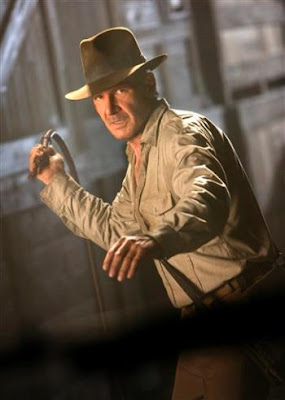 http://ap.google.com/article/ALeqM5jb68x_tOGx8QHjI0Cr6C-Vy79OGgD90SSR3G2
'Indiana Jones' unearths $126M in box office gold
By RYAN NAKASHIMA
5-25-8
LOS ANGELES (AP) — Indiana Jones unearthed box office gold at domestic theaters with a performance that puts it on track to become the second biggest Memorial Day movie opening ever, according to studio estimates Sunday.
The fourth installment of the whip-cracking professor's exploits, "Indiana Jones and the Kingdom of the Crystal Skull," grossed an estimated $101 million from Friday to Sunday, plus $25 million from its opening Thursday, distributor Paramount Pictures said. The company expects it to earn another $25 million on Monday.
That would put it behind only "Pirates of the Caribbean: At World's End," which had a Friday-through-Monday total of $139.8 million, in the pantheon of Memorial Day weekend blockbusters.
Including Thursday's receipts, "Indiana Jones" was expected to collect $151 million over five days, slightly behind "Pirates," which took in $153 million with a partial Thursday included.
"'Indiana Jones' did incredibly well for a film that comes 19 years after the previous installment," said Paul Dergarabedian, president of tracking firm Media By Numbers LLC.
The adventure flick received a lackluster reception from critics at the Cannes Film Festival, but audiences thought otherwise.
Box office estimates grew from $25 million on its opening Thursday through $37 million on Saturday, suggesting strong word of mouth, Dergarabedian said.
"This is the definition of a summer movie from two of the architects of the summer movie season — George Lucas and Steven Spielberg," he said. "These guys have it down to a science and audiences want to go along for that ride."
The first three Indy movies took in $1.2 billion worldwide.
By RYAN NAKASHIMA
5-25-8
LOS ANGELES (AP) — Indiana Jones unearthed box office gold at domestic theaters with a performance that puts it on track to become the second biggest Memorial Day movie opening ever, according to studio estimates Sunday.
The fourth installment of the whip-cracking professor's exploits, "Indiana Jones and the Kingdom of the Crystal Skull," grossed an estimated $101 million from Friday to Sunday, plus $25 million from its opening Thursday, distributor Paramount Pictures said. The company expects it to earn another $25 million on Monday.
That would put it behind only "Pirates of the Caribbean: At World's End," which had a Friday-through-Monday total of $139.8 million, in the pantheon of Memorial Day weekend blockbusters.
Including Thursday's receipts, "Indiana Jones" was expected to collect $151 million over five days, slightly behind "Pirates," which took in $153 million with a partial Thursday included.
"'Indiana Jones' did incredibly well for a film that comes 19 years after the previous installment," said Paul Dergarabedian, president of tracking firm Media By Numbers LLC.
The adventure flick received a lackluster reception from critics at the Cannes Film Festival, but audiences thought otherwise.
Box office estimates grew from $25 million on its opening Thursday through $37 million on Saturday, suggesting strong word of mouth, Dergarabedian said.
"This is the definition of a summer movie from two of the architects of the summer movie season — George Lucas and Steven Spielberg," he said. "These guys have it down to a science and audiences want to go along for that ride."
The first three Indy movies took in $1.2 billion worldwide.
Saturday, May 10, 2008
Indiana Jones and the Savior of a Lost Art
http://www.nytimes.com/2008/05/04/movies/moviesspecial/04raff.html
May 4, 2008
Summer Movies
Indiana Jones and the Savior of a Lost Art
By TERRENCE RAFFERTY
“THIS is a recreational activity for me” is surely among the last things you’d expect to hear from the director of a huge, costly, dauntingly complex summer action movie as it nears completion, with its release date just a few weeks away.
But that is what Steven Spielberg said not long ago, speaking by phone from a dub stage where he was supervising the sound mixing of “Indiana Jones and the Kingdom of the Crystal Skull” (opening May 22), the first new installment in 19 years of the crowd-pleasing adventure-movie franchise that began in 1981 with “Raiders of the Lost Ark.” “In 1989,” Mr. Spielberg said, referring to the year “Indiana Jones and the Last Crusade” came out, “I thought the curtain was lowering on the series, which is why I had all the characters literally ride off into the sunset at the end. But ever since then the most common question I get asked, all over the world, is, ‘When are you going to make another Indiana Jones?’ ”
It’s a fair guess that theater operators and executives at Paramount Pictures have asked that question at least as frequently as the ticket-buying public has, and perhaps with a shade more urgency: the three Indy pictures — “Indiana Jones and the Temple of Doom” (1984) was the one in the middle — have raked in well over a billion dollars worldwide from their theatrical releases alone. The anticipation, on the part of both the fans and the suits, falls somewhere between keen and breathless. And for most filmmakers that level of expectation might appear in their clammier dreams as a giant boulder bearing down on them and picking up speed.
“I’m having a great time,” Mr. Spielberg said. And, unlikely though this may seem, you can’t help believing him; he certainly sounds excited, and the secret of the Indiana Jones movies’ success has always been their free-spirited inventiveness, a what-the-hell quality that can’t (or shouldn’t) be faked, even on a gigantic budget.
Weirdly, authenticity — not faking it — is very much on his mind when he makes one of these unabashedly preposterous movies, whose hero (still played by Harrison Ford) is a two-fisted, bullwhip-wielding academic archaeologist zipping around the globe in search of rare mystical artifacts and in the process running afoul of Nazis, creepy human-sacrifice cults and other exemplars of unambiguous, unadulterated evil.
Even by the extremely flexible standards of high-adventure pulp, the Indy pictures are a pretty stern test of the audience’s willingness to suspend disbelief. (At times you feel as if it were hanging, as the hero periodically does, over a mass of writhing, fang-baring snakes, or a river full of famished crocodiles.) The authenticity Mr. Spielberg is concerned with here is something other than the historical realism of, say, “Schindler’s List” or “Munich”; what he wanted to talk about was the physical integrity of the action, of which there is, in an Indiana Jones movie, plenty.
The tone and style of the films derive from the movie serials of the 1930s and ’40s, which Mr. Spielberg, growing up in the ’50s, used to see on Saturday mornings at a revival theater in Scottsdale, Ariz.
“They made a great impression on me, both because of how exciting they were and because of how cheesy they were,” he said. “I’d kind of be involved in the stories and be ridiculing them at the same time. One week they’d give us a cliffhanger with the good guy going off the cliff, the car crashing on the rocks below and blowing up, and then the next week he’s fine. They forgot to show us the cut of the guy jumping out of the car? That we weren’t going to do in the Indiana Jones series.”
In fact, Mr. Spielberg said, he tries to cut as little as possible in these movies’ action sequences, because “every time the camera changes dynamic angles, you feel there’s something wrong, that there’s some cheating going on.” So his goal is “to do the shots the way Chaplin or Keaton would, everything happening before the eyes of the audience, without a cut.”
Warming to the subject, he went on: “The idea is, there’s no illusion; what you see is what you get. My movies have never been frenetically cut, the way a lot of action is done today. That’s not a put-down; some of that quick cutting, like in ‘The Bourne Ultimatum,’ is fantastic, just takes my breath away. But to get the comedy I want in the Indy films, you have to be old-fashioned. I’ve studied a lot of the old movies that made me laugh, and you’ve got to stage things in full shots and let the audience be the editor. It’s like every shot is a circus act.”
And in 1981, in “Raiders of the Lost Ark,” that approach was so old-fashioned it looked new. (It’s difficult to remember now just how stodgy and joyless the action genre had become; even the James Bond movies, reliably sprightly in the ’60s, turned into slow-footed, campy behemoths in the ’70s with entries like “Moonraker.”)
In the 27 years since, practically every action filmmaker has tried to drink from the grail of Indiana Jones, to tap into the movie’s quasi-mystical kinetic (and commercial) power: the pace had to be blindingly fast; the stunts insanely elaborate, the villainy extra-villainous; the hero’s attitude blithe, insouciant, almost sociopathically cool. Mr. Spielberg and George Lucas — who produces the movies and who dreamed up the basic idea of the series — have a lot to answer for.
The sad truth is that the enormous influence of the Indiana Jones films has been a distinctly mixed blessing. Action movies are, over all, a good deal snappier than they were 30 years ago, but they also tend to be a good deal less intelligible. They skimp on the exposition and go straight for sensation, as if cutting to the chase were not a metaphor but literally the cardinal rule of filmmaking. And that’s true not only of the most egregious Indiana Jones knockoffs — the “Mummy,” “National Treasure” and “Lara Croft” movies spring, unwelcomely, to mind — but of nearly every studio picture that features more action than, say, “My Dinner With André.” It’s no accident that movies of this sort, ubiquitous in summertime, are so often blurbed as “thrill rides”: they can be that exhausting, and that pointless.
Pointlessness is, however, in the eye of the beholder. When asked what kind of films he enjoyed most as a boy, Mr. Spielberg replied, simply, “Anything with a lot of movement,” and quite a few of us would say the same. Swift, thrilling motion is the hook that pulls young imaginations into movies, and although your taste might get a tad more refined over the years, vivid, intricate, ingeniously choreographed action can still give you that Saturday-matinee charge of pleasure.
The perilously long and complicated opening sequence of “Indiana Jones and the Temple of Doom” for example — in which a song-and-dance number (“Anything Goes,” sung in Mandarin) turns into a wild slapstick action scene involving a diamond, a poisoned drink and an elusive vial of antidote, and ends with Indy and his companions jumping out of a plane in a rubber raft — delivers that sort of giddy, mildly deranging stimulation. The staging and the cutting have the “can you top this?” audacity of a silent comedy, and the timing is slyly impeccable: it’s about the length of a Keaton two-reeler.
It hardly matters that the “Anything Goes” set piece was originally planned for “Raiders of the Lost Ark.” The big action scenes in the Indiana Jones movies are almost risibly inorganic to the narratives that contain them. This kind of randomness is risky — not to be tried at home, or by any filmmaker less prodigiously gifted than Mr. Spielberg. You need a rigorous imagination for visual comedy to make movies as exhilaratingly ridiculous as these.
“John Williams and I have a word we use when we have something we think the audience will love,” Mr. Spielberg said, referring to the composer who has scored all the Indiana Jones movies. “Maybe it’ll be a little over the top, and we ask each other, ‘Are we being too shameless?’ In a way I think we’ve both grown kind of proud of being shameless.”
When the jokes are good, as they frequently are in the Indy pictures, there’s every reason for pride. These goofy movies tell you as much about Steven Spielberg as his more serious work does. Movies truly are a form of recreation for him, and he’s the kind of artist who reveals himself fully in the intensity of his play. In the Indiana Jones movies he revives the spirit of silent comedy in the adventures of an intellectual with a bullwhip. And that’s a feat that, whether you think it’s worth doing or not, at least deserves high marks for degree of difficulty. If only everybody else in Hollywood hadn’t tried to imitate him, he’d have nothing to be ashamed of at all.
May 4, 2008
Summer Movies
Indiana Jones and the Savior of a Lost Art
By TERRENCE RAFFERTY
“THIS is a recreational activity for me” is surely among the last things you’d expect to hear from the director of a huge, costly, dauntingly complex summer action movie as it nears completion, with its release date just a few weeks away.
But that is what Steven Spielberg said not long ago, speaking by phone from a dub stage where he was supervising the sound mixing of “Indiana Jones and the Kingdom of the Crystal Skull” (opening May 22), the first new installment in 19 years of the crowd-pleasing adventure-movie franchise that began in 1981 with “Raiders of the Lost Ark.” “In 1989,” Mr. Spielberg said, referring to the year “Indiana Jones and the Last Crusade” came out, “I thought the curtain was lowering on the series, which is why I had all the characters literally ride off into the sunset at the end. But ever since then the most common question I get asked, all over the world, is, ‘When are you going to make another Indiana Jones?’ ”
It’s a fair guess that theater operators and executives at Paramount Pictures have asked that question at least as frequently as the ticket-buying public has, and perhaps with a shade more urgency: the three Indy pictures — “Indiana Jones and the Temple of Doom” (1984) was the one in the middle — have raked in well over a billion dollars worldwide from their theatrical releases alone. The anticipation, on the part of both the fans and the suits, falls somewhere between keen and breathless. And for most filmmakers that level of expectation might appear in their clammier dreams as a giant boulder bearing down on them and picking up speed.
“I’m having a great time,” Mr. Spielberg said. And, unlikely though this may seem, you can’t help believing him; he certainly sounds excited, and the secret of the Indiana Jones movies’ success has always been their free-spirited inventiveness, a what-the-hell quality that can’t (or shouldn’t) be faked, even on a gigantic budget.
Weirdly, authenticity — not faking it — is very much on his mind when he makes one of these unabashedly preposterous movies, whose hero (still played by Harrison Ford) is a two-fisted, bullwhip-wielding academic archaeologist zipping around the globe in search of rare mystical artifacts and in the process running afoul of Nazis, creepy human-sacrifice cults and other exemplars of unambiguous, unadulterated evil.
Even by the extremely flexible standards of high-adventure pulp, the Indy pictures are a pretty stern test of the audience’s willingness to suspend disbelief. (At times you feel as if it were hanging, as the hero periodically does, over a mass of writhing, fang-baring snakes, or a river full of famished crocodiles.) The authenticity Mr. Spielberg is concerned with here is something other than the historical realism of, say, “Schindler’s List” or “Munich”; what he wanted to talk about was the physical integrity of the action, of which there is, in an Indiana Jones movie, plenty.
The tone and style of the films derive from the movie serials of the 1930s and ’40s, which Mr. Spielberg, growing up in the ’50s, used to see on Saturday mornings at a revival theater in Scottsdale, Ariz.
“They made a great impression on me, both because of how exciting they were and because of how cheesy they were,” he said. “I’d kind of be involved in the stories and be ridiculing them at the same time. One week they’d give us a cliffhanger with the good guy going off the cliff, the car crashing on the rocks below and blowing up, and then the next week he’s fine. They forgot to show us the cut of the guy jumping out of the car? That we weren’t going to do in the Indiana Jones series.”
In fact, Mr. Spielberg said, he tries to cut as little as possible in these movies’ action sequences, because “every time the camera changes dynamic angles, you feel there’s something wrong, that there’s some cheating going on.” So his goal is “to do the shots the way Chaplin or Keaton would, everything happening before the eyes of the audience, without a cut.”
Warming to the subject, he went on: “The idea is, there’s no illusion; what you see is what you get. My movies have never been frenetically cut, the way a lot of action is done today. That’s not a put-down; some of that quick cutting, like in ‘The Bourne Ultimatum,’ is fantastic, just takes my breath away. But to get the comedy I want in the Indy films, you have to be old-fashioned. I’ve studied a lot of the old movies that made me laugh, and you’ve got to stage things in full shots and let the audience be the editor. It’s like every shot is a circus act.”
And in 1981, in “Raiders of the Lost Ark,” that approach was so old-fashioned it looked new. (It’s difficult to remember now just how stodgy and joyless the action genre had become; even the James Bond movies, reliably sprightly in the ’60s, turned into slow-footed, campy behemoths in the ’70s with entries like “Moonraker.”)
In the 27 years since, practically every action filmmaker has tried to drink from the grail of Indiana Jones, to tap into the movie’s quasi-mystical kinetic (and commercial) power: the pace had to be blindingly fast; the stunts insanely elaborate, the villainy extra-villainous; the hero’s attitude blithe, insouciant, almost sociopathically cool. Mr. Spielberg and George Lucas — who produces the movies and who dreamed up the basic idea of the series — have a lot to answer for.
The sad truth is that the enormous influence of the Indiana Jones films has been a distinctly mixed blessing. Action movies are, over all, a good deal snappier than they were 30 years ago, but they also tend to be a good deal less intelligible. They skimp on the exposition and go straight for sensation, as if cutting to the chase were not a metaphor but literally the cardinal rule of filmmaking. And that’s true not only of the most egregious Indiana Jones knockoffs — the “Mummy,” “National Treasure” and “Lara Croft” movies spring, unwelcomely, to mind — but of nearly every studio picture that features more action than, say, “My Dinner With André.” It’s no accident that movies of this sort, ubiquitous in summertime, are so often blurbed as “thrill rides”: they can be that exhausting, and that pointless.
Pointlessness is, however, in the eye of the beholder. When asked what kind of films he enjoyed most as a boy, Mr. Spielberg replied, simply, “Anything with a lot of movement,” and quite a few of us would say the same. Swift, thrilling motion is the hook that pulls young imaginations into movies, and although your taste might get a tad more refined over the years, vivid, intricate, ingeniously choreographed action can still give you that Saturday-matinee charge of pleasure.
The perilously long and complicated opening sequence of “Indiana Jones and the Temple of Doom” for example — in which a song-and-dance number (“Anything Goes,” sung in Mandarin) turns into a wild slapstick action scene involving a diamond, a poisoned drink and an elusive vial of antidote, and ends with Indy and his companions jumping out of a plane in a rubber raft — delivers that sort of giddy, mildly deranging stimulation. The staging and the cutting have the “can you top this?” audacity of a silent comedy, and the timing is slyly impeccable: it’s about the length of a Keaton two-reeler.
It hardly matters that the “Anything Goes” set piece was originally planned for “Raiders of the Lost Ark.” The big action scenes in the Indiana Jones movies are almost risibly inorganic to the narratives that contain them. This kind of randomness is risky — not to be tried at home, or by any filmmaker less prodigiously gifted than Mr. Spielberg. You need a rigorous imagination for visual comedy to make movies as exhilaratingly ridiculous as these.
“John Williams and I have a word we use when we have something we think the audience will love,” Mr. Spielberg said, referring to the composer who has scored all the Indiana Jones movies. “Maybe it’ll be a little over the top, and we ask each other, ‘Are we being too shameless?’ In a way I think we’ve both grown kind of proud of being shameless.”
When the jokes are good, as they frequently are in the Indy pictures, there’s every reason for pride. These goofy movies tell you as much about Steven Spielberg as his more serious work does. Movies truly are a form of recreation for him, and he’s the kind of artist who reveals himself fully in the intensity of his play. In the Indiana Jones movies he revives the spirit of silent comedy in the adventures of an intellectual with a bullwhip. And that’s a feat that, whether you think it’s worth doing or not, at least deserves high marks for degree of difficulty. If only everybody else in Hollywood hadn’t tried to imitate him, he’d have nothing to be ashamed of at all.
Tuesday, April 8, 2008
Spielberg casts British teenager as Tintin
http://www.telegraph.co.uk/arts/main.jhtml?xml=/arts/2008/03/28/bbtintin128.xml
Spielberg casts British teenager as Tintin
By Lucy Cockcroft
28/03/2008
A British teenager has been selected by Steven Spielberg to star as Tintin in a series of three films about the boy journalist.
Thomas Sangster, 17, who played the role of Liam Neeson’s step son in Love Actually, had originally sent an audition tape to the Hollywood director hoping to snare a role in The Talisman, a project which never got off the ground.
Instead Spielberg realised he had found the boy who could play Tintin, the young adventurer created by Belgian cartoonist and writer Georges Prosper Remi, better known by his pen name of Hergé.
Spielberg has been working with The Lord of the Rings director Peter Jackson on how to bring Tintin, instantly recognisable by his blonde quiff and faithful side-kick Snowy the dog, to life.
All the regular characters are expected to be in the new movies, including the oafish detectives Thomson and Thompson and the virtually deaf Professor Cuthbert Calculus. Andy Serkis, who played Gollum in the adaptation of Tolkien’s books, has already been cast as Tintin’s friend Captain Haddock.
But it is not yet known which of the 23 Tintin stories will be filmed. And while Spielberg will direct one and Jackson one, it is still not known who will direct the third. They will be filmed back to back in the US and New Zealand, using the latest 3D technology.
Spielberg said: “We want Tintin’s adventures to have the reality of a live action film and yet Peter and I felt that shooting them in a traditional live action format would simply not honour the distinctive look of the characters and world that Hergé created.
“The idea is that the films will look neither like cartoons nor like computer-generated animation. We’re making them look photo-realistic, the fibres of their clothing, the pores of their skin and each individual hair. They look exactly like real people - but real Hergé people.”
More than 200 million copies of Hergé’s The Adventures of Tintin books, a series written between 1929 until his death in 1983, have been sold around the world.
Spielberg casts British teenager as Tintin
By Lucy Cockcroft
28/03/2008
A British teenager has been selected by Steven Spielberg to star as Tintin in a series of three films about the boy journalist.
Thomas Sangster, 17, who played the role of Liam Neeson’s step son in Love Actually, had originally sent an audition tape to the Hollywood director hoping to snare a role in The Talisman, a project which never got off the ground.
Instead Spielberg realised he had found the boy who could play Tintin, the young adventurer created by Belgian cartoonist and writer Georges Prosper Remi, better known by his pen name of Hergé.
Spielberg has been working with The Lord of the Rings director Peter Jackson on how to bring Tintin, instantly recognisable by his blonde quiff and faithful side-kick Snowy the dog, to life.
All the regular characters are expected to be in the new movies, including the oafish detectives Thomson and Thompson and the virtually deaf Professor Cuthbert Calculus. Andy Serkis, who played Gollum in the adaptation of Tolkien’s books, has already been cast as Tintin’s friend Captain Haddock.
But it is not yet known which of the 23 Tintin stories will be filmed. And while Spielberg will direct one and Jackson one, it is still not known who will direct the third. They will be filmed back to back in the US and New Zealand, using the latest 3D technology.
Spielberg said: “We want Tintin’s adventures to have the reality of a live action film and yet Peter and I felt that shooting them in a traditional live action format would simply not honour the distinctive look of the characters and world that Hergé created.
“The idea is that the films will look neither like cartoons nor like computer-generated animation. We’re making them look photo-realistic, the fibres of their clothing, the pores of their skin and each individual hair. They look exactly like real people - but real Hergé people.”
More than 200 million copies of Hergé’s The Adventures of Tintin books, a series written between 1929 until his death in 1983, have been sold around the world.
Wednesday, March 12, 2008
Five things that Dungeons & Dragons begat
http://news.bbc.co.uk/1/hi/magazine/7280969.stm
Five things that Dungeons & Dragons begat
One of the creators of the role-playing game Dungeons & Dragons, Gary Gygax, has died. While the game's heyday has passed, its cultural influence bestrides gaming and how the media views young people.
ONLINE ROLE-PLAY GAMING
Without Dungeons & Dragons (D&D) it is hard to imagine the massively successful World of Warcraft. Both games immerse the user in a fantasy realm which appears on the surface to owe more than a little to Lord of the Rings.
Both are based on systems where characters can improve their attributes by gaining credit for game actions. Gains come from experience or honour points in World of Warcraft, following on from the experience points scheme in D&D. Both games have also converted early cult appeal into global phenomenon status.
D&D completed its journey into the cultural mainstream, when it featured in a scene near the beginning of Steven Spielberg's ET, without the need for any explanation. Younger members of the audience might very well have played it or known people who had. Older members of the audience probably knew about it through the media.
THE GEEK RAMPANT
Geek was, and remains to many, an offensive term. It has been a stick with which to beat anybody who does not enjoy all of the cultural and social values of the majority. Anybody who had an interest in computers, science fiction, fantasy literature or collecting comics could be easily dismissed as a geek once upon a time.
And the key thing with the classic "geek" pastimes was that they were - except for the occasional convention - typically fairly solitary pursuits.
Dungeons & Dragons had a number of effects. It brought so-called geeks together in a social setting as a matter of course, it quickly spread out into the mainstream, and it signalled that money could be made out of catering for previously niche audiences.
The game has also left a legacy of subcultures like live action role-play and online gaming, where there is a pronounced social element. The world we live in now, where "gaining friends" on social networking sites is regarded as a totally reasonable pastime, is a very different world to that in which Dungeons & Dragons made its debut in 1974.
REVIVING FANTASY MANIA
Fantasy can be regarded as perhaps the oldest genre in storytelling, but its popularity in the modern era has ebbed and flowed.
Despite the protestations of creators and fans that D&D was not a slavish aping of the Lord of the Rings trilogy, it seems fair to suggest that it provided another source of enthusiasm for Tolkien's classics as well as boosting interest in a host of successors like David Eddings and Terry Pratchett. Games inspired by D&D such as Call of Cthulhu created new fans for authors like HP Lovecraft.
D&D's success in the late 1970s and 1980s represents a high watermark in the popularity and ubiquity of the fantasy genre along with the original publication in 1954/5 of the Lord of the Rings and the recent film adaptations.
TEENAGE GAMING MORAL PANICS
Moral panics about young people have been about since the dawn of the mass media, but Dungeons & Dragons cemented a link in the mind of worried parents between gaming and fears of effects on teenager's behaviour.
Today the focus is much more likely to be on violent video games like Manhunt, but in the 1980s there were people worrying about games like D&D. It was linked by campaigners to a number of suicides, the suggestion being that teenagers had become so immersed in the game that they had struggled to separate fantasy and reality.
Now paranoid parents would be more likely to suffer misty-eyed nostalgia over the era when gaming involved constant and varied use of the young mind's imagination, as opposed to today's games which typically offer the user images where once there was only the mind's eye.
Online gaming like World of Warcraft is suffering its fair share of concerns, particularly in the Far East, where there are fears of widespread addiction and detrimental effects on intensive users' health.
The message in circulation has remained constant since the rise of D&D - immersive game-playing by young people should be a cause of concern for adults.
MANY-SIDED DICE
Before Dungeons & Dragons, anyone wielding a dodecahedral or icosahedral die in the playground would have been regarded with wide-eyed bemusement.
During the game's popularity and in the wake of the slew of imitators it inspired, they became a common sight for some years.
Even with the rise of the video game, Dungeons and Dragons' influence rolls on.
Five things that Dungeons & Dragons begat
One of the creators of the role-playing game Dungeons & Dragons, Gary Gygax, has died. While the game's heyday has passed, its cultural influence bestrides gaming and how the media views young people.
ONLINE ROLE-PLAY GAMING
Without Dungeons & Dragons (D&D) it is hard to imagine the massively successful World of Warcraft. Both games immerse the user in a fantasy realm which appears on the surface to owe more than a little to Lord of the Rings.
Both are based on systems where characters can improve their attributes by gaining credit for game actions. Gains come from experience or honour points in World of Warcraft, following on from the experience points scheme in D&D. Both games have also converted early cult appeal into global phenomenon status.
D&D completed its journey into the cultural mainstream, when it featured in a scene near the beginning of Steven Spielberg's ET, without the need for any explanation. Younger members of the audience might very well have played it or known people who had. Older members of the audience probably knew about it through the media.
THE GEEK RAMPANT
Geek was, and remains to many, an offensive term. It has been a stick with which to beat anybody who does not enjoy all of the cultural and social values of the majority. Anybody who had an interest in computers, science fiction, fantasy literature or collecting comics could be easily dismissed as a geek once upon a time.
And the key thing with the classic "geek" pastimes was that they were - except for the occasional convention - typically fairly solitary pursuits.
Dungeons & Dragons had a number of effects. It brought so-called geeks together in a social setting as a matter of course, it quickly spread out into the mainstream, and it signalled that money could be made out of catering for previously niche audiences.
The game has also left a legacy of subcultures like live action role-play and online gaming, where there is a pronounced social element. The world we live in now, where "gaining friends" on social networking sites is regarded as a totally reasonable pastime, is a very different world to that in which Dungeons & Dragons made its debut in 1974.
REVIVING FANTASY MANIA
Fantasy can be regarded as perhaps the oldest genre in storytelling, but its popularity in the modern era has ebbed and flowed.
Despite the protestations of creators and fans that D&D was not a slavish aping of the Lord of the Rings trilogy, it seems fair to suggest that it provided another source of enthusiasm for Tolkien's classics as well as boosting interest in a host of successors like David Eddings and Terry Pratchett. Games inspired by D&D such as Call of Cthulhu created new fans for authors like HP Lovecraft.
D&D's success in the late 1970s and 1980s represents a high watermark in the popularity and ubiquity of the fantasy genre along with the original publication in 1954/5 of the Lord of the Rings and the recent film adaptations.
TEENAGE GAMING MORAL PANICS
Moral panics about young people have been about since the dawn of the mass media, but Dungeons & Dragons cemented a link in the mind of worried parents between gaming and fears of effects on teenager's behaviour.
Today the focus is much more likely to be on violent video games like Manhunt, but in the 1980s there were people worrying about games like D&D. It was linked by campaigners to a number of suicides, the suggestion being that teenagers had become so immersed in the game that they had struggled to separate fantasy and reality.
Now paranoid parents would be more likely to suffer misty-eyed nostalgia over the era when gaming involved constant and varied use of the young mind's imagination, as opposed to today's games which typically offer the user images where once there was only the mind's eye.
Online gaming like World of Warcraft is suffering its fair share of concerns, particularly in the Far East, where there are fears of widespread addiction and detrimental effects on intensive users' health.
The message in circulation has remained constant since the rise of D&D - immersive game-playing by young people should be a cause of concern for adults.
MANY-SIDED DICE
Before Dungeons & Dragons, anyone wielding a dodecahedral or icosahedral die in the playground would have been regarded with wide-eyed bemusement.
During the game's popularity and in the wake of the slew of imitators it inspired, they became a common sight for some years.
Even with the rise of the video game, Dungeons and Dragons' influence rolls on.
Thursday, February 21, 2008
Sacha Baron Cohen in Spielberg's 'Seven'
http://www.ew.com/ew/article/0,,20168710,00.html
Sacha Baron Cohen in Spielberg's 'Seven'
London's "Sunday Times" reports that Steven Spielberg persuaded the actor to play Vietnam War activist Abbie Hoffman in DreamWorks' "The Trial of the Chicago Seven"
Posted Jan 02, 2008
(FROM THE SUNDAY TIMES) – Sacha Baron Cohen will play 1960s Vietnam War protester Abbie Hoffman for The Trial of the Chicago Seven, a project Steven Spielberg is developing for DreamWorks, according to London's Sunday Times newspaper. Variety reports that reps for Spielberg would neither confirm nor deny the report, which claims that Spielberg persuaded the actor to join the project. The movie tells the story of the seven protesters who were put on trial after disrupting the 1968 Democratic Party convention with a Vietnam War protest, which was met with fierce police resistance. Hoffman was one of the seven who had to fight charges of inciting a riot. DreamWorks worked out a deal with Aaron Sorkin in July to write the script. Spielberg is producing alongside Walter Parkes and Laurie MacDonald. Baron Cohen is currently in theaters for Sweeney Todd and is working on a movie based on his character Bruno, an Austrian fashion designer. (The Sunday Times)
Sacha Baron Cohen in Spielberg's 'Seven'
London's "Sunday Times" reports that Steven Spielberg persuaded the actor to play Vietnam War activist Abbie Hoffman in DreamWorks' "The Trial of the Chicago Seven"
Posted Jan 02, 2008
(FROM THE SUNDAY TIMES) – Sacha Baron Cohen will play 1960s Vietnam War protester Abbie Hoffman for The Trial of the Chicago Seven, a project Steven Spielberg is developing for DreamWorks, according to London's Sunday Times newspaper. Variety reports that reps for Spielberg would neither confirm nor deny the report, which claims that Spielberg persuaded the actor to join the project. The movie tells the story of the seven protesters who were put on trial after disrupting the 1968 Democratic Party convention with a Vietnam War protest, which was met with fierce police resistance. Hoffman was one of the seven who had to fight charges of inciting a riot. DreamWorks worked out a deal with Aaron Sorkin in July to write the script. Spielberg is producing alongside Walter Parkes and Laurie MacDonald. Baron Cohen is currently in theaters for Sweeney Todd and is working on a movie based on his character Bruno, an Austrian fashion designer. (The Sunday Times)
'Star Wars: The Clone Wars' due Aug. 15
http://www.calendarlive.com/tv/cl-et-clone13feb13,0,6476102.story
'Star Wars: The Clone Wars' due Aug. 15
The computer-animated film will act as a feature-length preview for George Lucas' new cable television series.
By Geoff Boucher
Los Angeles Times Staff Writer
February 13, 2008
First "Indiana Jones," and now "Star Wars" -- this summer is turning out to be the season of George Lucas.
"Star Wars: The Clone Wars," a new stylized, computer-animated feature film, will open Aug. 15 in theaters and set the stage for a tie-in television series with the same name and mode of artwork that will begin airing as a 30-minute weekly series in the fall on the Cartoon Network and TNT.
The film and series will center on the wartime tales of Anakin Skywalker and Obi-Wan Kenobi and feature Padme Amidala, Mace Windu, Count Dooku and the other characters introduced in the second trilogy of live-action "Star Wars" films that began in 1999.
For casual fans trying to keep track of the timeline, this film and series would take place after the events of the 2002 movie "Attack of the Clones" and right before those in the grimmer 2005 installment "Revenge of the Sith," which shows Anakin succumbing to the dark side of the Force and donning the black cape of Darth Vader.
"I felt like there were a lot more 'Star Wars' stories left to tell," Lucas said in a Tuesday press release. "I was eager to start telling some of them through animation and, at the same time, push the art of the animation forward."
There already was a 2-D animated series called "Clone Wars" that centered on the conflict between the Jedis of the Republic and separatist groups and their battle droids, but this new film and series will be later in the continuity and have a dramatically different look that melds photo-realistic battle sequences (think of an enhanced, top-flight video game) and stylized characters that sometimes resemble marionettes.
Lucas has also said that he is working toward a live-action television series based in the "Star Wars" universe but that it would not feature the central characters of the iconic franchise, which has grossed $4.3 billion in theaters worldwide. "It's about minor characters," the filmmaker told The Times in October. "It has nothing to do with Luke Skywalker or Darth Vader or any of those people. It's completely different. But it's a good idea, and it's going to be a lot of fun to do."
The other famous franchise associated with Lucas is swinging back this year as well. "Indiana Jones and the Kingdom of the Crystal Skull" arrives on Memorial Day and brings the feisty archaeologist of the title back to theaters for the first time since 1989. Lucas, who created the character, is executive producer and shares writing credits with David Koepp. Steven Spielberg returns as the franchise's director.
geoff.boucher@latimes.com
'Star Wars: The Clone Wars' due Aug. 15
The computer-animated film will act as a feature-length preview for George Lucas' new cable television series.
By Geoff Boucher
Los Angeles Times Staff Writer
February 13, 2008
First "Indiana Jones," and now "Star Wars" -- this summer is turning out to be the season of George Lucas.
"Star Wars: The Clone Wars," a new stylized, computer-animated feature film, will open Aug. 15 in theaters and set the stage for a tie-in television series with the same name and mode of artwork that will begin airing as a 30-minute weekly series in the fall on the Cartoon Network and TNT.
The film and series will center on the wartime tales of Anakin Skywalker and Obi-Wan Kenobi and feature Padme Amidala, Mace Windu, Count Dooku and the other characters introduced in the second trilogy of live-action "Star Wars" films that began in 1999.
For casual fans trying to keep track of the timeline, this film and series would take place after the events of the 2002 movie "Attack of the Clones" and right before those in the grimmer 2005 installment "Revenge of the Sith," which shows Anakin succumbing to the dark side of the Force and donning the black cape of Darth Vader.
"I felt like there were a lot more 'Star Wars' stories left to tell," Lucas said in a Tuesday press release. "I was eager to start telling some of them through animation and, at the same time, push the art of the animation forward."
There already was a 2-D animated series called "Clone Wars" that centered on the conflict between the Jedis of the Republic and separatist groups and their battle droids, but this new film and series will be later in the continuity and have a dramatically different look that melds photo-realistic battle sequences (think of an enhanced, top-flight video game) and stylized characters that sometimes resemble marionettes.
Lucas has also said that he is working toward a live-action television series based in the "Star Wars" universe but that it would not feature the central characters of the iconic franchise, which has grossed $4.3 billion in theaters worldwide. "It's about minor characters," the filmmaker told The Times in October. "It has nothing to do with Luke Skywalker or Darth Vader or any of those people. It's completely different. But it's a good idea, and it's going to be a lot of fun to do."
The other famous franchise associated with Lucas is swinging back this year as well. "Indiana Jones and the Kingdom of the Crystal Skull" arrives on Memorial Day and brings the feisty archaeologist of the title back to theaters for the first time since 1989. Lucas, who created the character, is executive producer and shares writing credits with David Koepp. Steven Spielberg returns as the franchise's director.
geoff.boucher@latimes.com
Sunday, December 2, 2007
Tom Cruise Had Spielberg's Family Doctor Picketed
http://www.huffingtonpost.com/2007/11/29/tom-cruise-had-spielberg_n_74731.html
Tom Cruise Had Spielberg's Family Doctor Picketed By Scientologists
Katherine Thomson
November 29, 2007
Deep in the December issue of Vanity Fair is an interesting throw-away line about Tom Cruise and Steven Spielberg. Bryan Burrough wrote a lengthy article called:
Showdown at Fort Sumner
Two years after Paramount purchased DreamWorks, Hollywood is transfixed by one of the nastiest breakups ever. As Sumner Redstone and David Geffen went to war (over Steven Spielberg?), the author got it from both sides.
The article is online, and on page 3 of the online copy, at the end of a paragraph on Tom Cruise being "fired" by Redstone, is this:
Spielberg felt the actor's antics had hurt his own movie, 2005's War of the Worlds. Far worse, though, had been an episode when Spielberg told Cruise the name of a doctor who had prescribed medication to a relative and the doctor's office was subsequently picketed by Scientologists.
The Cruise dismissal, however, was nothing compared to the sudden firing of Freston as Viacom's C.E.O., two weeks later....
Vanity Fair has stringent fact checkers. To repeat "when Spielberg told Cruise the name of a doctor who had prescribed medication to a relative and the doctor's office was subsequently picketed by Scientologists."
The sentence begs the question, what kind of doctor and medication? Could it be psychiatric? Cruise and Scientology have a well-documented opposition to psychiatry, and now it seems Spielberg has a documented dislike of Cruise.
Tom Cruise Had Spielberg's Family Doctor Picketed By Scientologists
Katherine Thomson
November 29, 2007
Deep in the December issue of Vanity Fair is an interesting throw-away line about Tom Cruise and Steven Spielberg. Bryan Burrough wrote a lengthy article called:
Showdown at Fort Sumner
Two years after Paramount purchased DreamWorks, Hollywood is transfixed by one of the nastiest breakups ever. As Sumner Redstone and David Geffen went to war (over Steven Spielberg?), the author got it from both sides.
The article is online, and on page 3 of the online copy, at the end of a paragraph on Tom Cruise being "fired" by Redstone, is this:
Spielberg felt the actor's antics had hurt his own movie, 2005's War of the Worlds. Far worse, though, had been an episode when Spielberg told Cruise the name of a doctor who had prescribed medication to a relative and the doctor's office was subsequently picketed by Scientologists.
The Cruise dismissal, however, was nothing compared to the sudden firing of Freston as Viacom's C.E.O., two weeks later....
Vanity Fair has stringent fact checkers. To repeat "when Spielberg told Cruise the name of a doctor who had prescribed medication to a relative and the doctor's office was subsequently picketed by Scientologists."
The sentence begs the question, what kind of doctor and medication? Could it be psychiatric? Cruise and Scientology have a well-documented opposition to psychiatry, and now it seems Spielberg has a documented dislike of Cruise.
Subscribe to:
Posts (Atom)

 Posts
Posts


