Showing posts with label Blade Runner. Show all posts

Sunday, June 17, 2012

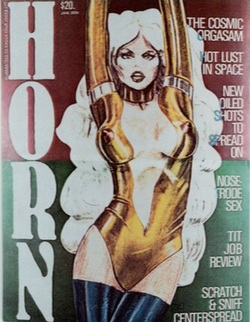
Blade Runner Magazine Covers


These magazine covers can be seen in the movie Blade Runner, and thanks to a devoted fanbase, it is now available on the web.  Here's where you can see them all:


http://sciencefiction.tumblr.com/post/23608072333/these-are-fictional-magazine-covers-from-blade


Thursday, August 18, 2011

Fassbinder's "World on a Wire" Cryogenically Frozen, But Still Fresh

Film Review
Jonathan Kiefer | Jul 29, 2011
http://www.kqed.org/arts/movies/article.jsp?essid=62773

He was young when he made it, but he was always young. Having died at 37 from overdoing drugs and work, he completed more films than years of life. And it is dated, but there is fresh delight in the correlation of datedness to its endurance. Not just because it has been unavailable all these years, accumulating mystique, but also for being so clearly ahead of its time to begin with.

It is World on a Wire, the rarely seen 1973 TV movie by New German Cinema mainstay Rainer Werner Fassbinder, newly restored, making the rounds in limited release, and worth catching even if you don't think you have three and a half hours to spare. What makes you so sure it isn't really a matter of time having you to spare?

Here's what you should know. Derived from Daniel F. Galouye's 1964 novel Simulacron 3, it involves a sinister corporate-controlled virtual-reality situation, with related philosophical questions. In the filmmaker's own words, "Perhaps another, larger world has made us as a virtual one? In this sense it deals with the old philosophical model, which here takes on a certain horror."

It's as you always suspected: The movies had a dystopian Euro-chic cyberworld rabbit hole long before The Matrix, and also a grubby sardonic preemptive rebuke to the moneyed hokum that was Avatar. Here, instead of the glum self-seriousness of Blade Runner, warmed over once again, we have the glum self-seriousness of Fassbinder, cryogenically frozen but still so fresh!

Our hero here, played by Klaus Löwitsch, is a cybernetics engineer working on what he calls "the most exciting research project in the entire world," not wrongly, but not quite comprehendingly either. With dubious help from a small array of blank-faced blondes (Mascha Rabben, svelte; Barbara Valentin, buxom), he finds himself negotiating the variously expressed sudden nonexistence of several colleagues.

World on a Wire is willfully dense, a noirish sci-fi puzzler with a hint of James Bond and occasional soap suds bubbling up from its glassy concourse into the air of grainy fluorescence. Jean-Luc Godard's Alphaville also was a model, for taking an available actual world to be plenty ominous and science-fiction-like as it is, and Fassbinder gets much power from the blunt, quaint aesthetic of '70s-style futurism, with its plasticky furniture, its ties and sideburns of formidable width, its groping zooms.

He does well by his own usual style, too. It's all so flatly lit and acted as to seem somehow invitingly morose. Supporting players don't really support so much as lurk and pout. Quite often the whole ensemble seems like some vast, ambitiously arty punk band, having a (deadpan) laugh at the expense of the rest of us market-driven "identity units."

Obviously alienated by the post-fascist "economic miracle" and hostile to West German complacency, Fassbinder took interest in oppression as both a topic and a practice. An imperious yet sensitive soul, he could make Hollywood genre deconstruction seem at once like seething and like picking lint. And so he recognized the potential of a liberatingly perfunctory plot -- which is to say he knew going in to this latent existential classic what the rest of us have since taken many movies to figure out.

Wednesday, May 28, 2008

A Developer’s Unusual Plan for Bright Lights

http://www.nytimes.com/2008/05/21/arts/design/21blad.html

May 21, 2008
A Developer’s Unusual Plan for Bright Lights, Inspired by a Dark Film
By REBECCA CATHCART

LOS ANGELES — The year is 2019. The illuminated windows of the city’s densely packed towers sparkle like stars in the night, and their facades are covered with bright, animated billboards. A flying car glides past the enormous eye of a smiling geisha hundreds of stories above the wet urban streets.

That is the world of “Blade Runner,” Ridley Scott’s 1982 film set in a futuristic dystopia. It is also an obsession of a real estate developer, Sonny Astani, who hopes to evoke those atmospherics by affixing rows of light-emitting diodes, or LEDs, to the facades of his two newest condominium towers in downtown Los Angeles.

“That movie really hit a chord with me,” Mr. Astani, 55, said with a broad smile. “It was beautiful.”

On a recent afternoon in his Beverly Hills office, he held up digital renderings of the two buildings, the geisha’s face from “Blade Runner” superimposed on their facades.

“I saw ‘Blade Runner’ at a time when L.A. was feeling like that,” he said. “I was feeling like that.”

In 1982 Mr. Astani was a struggling real estate broker here. He had come to Los Angeles from Tehran six years earlier to study engineering at the University of Southern California, with plans to return home after graduation. The Iranian revolution changed that. He never went back.

The dark mood of “Blade Runner” matched his own melancholy at the time, Mr. Astani said, and he was gripped by the notion of looming skyscrapers covered with moving images and graphics, and the layering of old and new structures. Today Mr. Astani is a successful businessman, with two million square feet of downtown real estate built or in development, including six tall residential buildings. His projects are part of a wave of development in the area that began around 2001 and gained momentum in 2003, when Los Angeles expanded adaptive reuse policies similar to those of New York.

“Everyone wants downtown to happen,” he said. “This could create some excitement and conversation,” he said of his “Blade Runner”-inspired facades.

His 30-story residential towers, scheduled to be completed in 2009, sit at the north end of an evolving entertainment district anchored by the Stapes Center and L.A. Live, a sports and entertainment complex sometimes described as Times Square West.

The area already has plenty of loud billboards and klieg lights that have drawn complaints from some neighborhood groups, so the city is concerned about anything billboardesque. Mr. Astani’s application to build the LED panels is undergoing an environmental review by city planning officials.

He has taken pains to distinguish his project from typical LED billboards with bright, fast-paced graphics. His panels would shine with one-sixth the intensity of ordinary models; adjust their brightness at different times of the day; and project slower-moving images, according to the ordinance application. They would cover about 10 stories on just one side of each building.

The panels would appear solid from a distance, although they consist of horizontal blades spaced six inches apart, like large blinds. Only a half-inch thick and three inches wide, each one carries a single row of diodes.

The blades were designed by Frederic Opsomer, who is also known for creating spectacular video, light and stage designs for pop-music acts. The only other building clad in similar LED blades is the T-Mobile headquarters in Bonn, Mr. Astani said. The screens would feature mostly paid advertisements but would include work by local artists and ads for nonprofit groups 20 percent of the time. The technology and content have sowed some confusion among the city officials weighing Mr. Astani’s application.

“The issue of it potentially being viewed as art has complicated it,” said Patricia Diefenderfer, of the Los Angeles Planning Department.

“We’re treating it like a sign,” she said. “Signs are a stimulus. They clutter our environment and can assault us, in a sense. This is something very large. What is the impact? What does that mean?”

Yet Eric Lynxwiler, a downtown resident and author who leads nighttime tours of the city’s neon signs for the Museum of Neon Art, favors the project.

“I think he scared far too many people when he compared it to ‘Blade Runner,’ ” Mr. Lynxwiler said of Mr. Astani. “But I remember L.A. as it was — dark, more like ‘Blade Runner’ before the development,” he said, describing streets that were mostly empty after 6 p.m. “I think downtown definitely has the vibe to support something that large, that new and that bold and daring.”

Syd Mead, a visual-effects artist who worked on “Blade Runner,” said that the city’s once-haunted look is what inspired Mr. Scott to film there. The director was also taken with the eclectic downtown mix of newer structures and historic buildings, he said.

That the movie could inspire innovation is not a surprise, Mr. Mead said, adding, “I’ve called science fiction ‘reality ahead of schedule.’ ”

Friday, November 16, 2007

Blade Runner: The Final Cut

http://rogerebert.suntimes.com/apps/pbcs.dll/article?AID=/20071103/REVIEWS08/71103001/1004

Great Movies
Blade Runner: The Final CutGreat Scott
Release Date: 1982
Nov 3, 2007
By Roger Ebert

In an earlier review of "Blade Runner," I wrote; "It looks fabulous, it uses special effects to create a new world of its own, but it is thin in its human story." This seems a strange complaint, given that so much of the movie concerns who is, and is not, human, and what it means to be human anyway. Even one character we can safely assume is human, the reptilian Tyrell, czar of the corporation which manufactures replicants, strikes me as a possible replicant. And of the hero, Deckard (Harrison Ford), all we can say for sure is that director Ridley Scott has left clues in various versions of his film that can be used to prove that Deckard is a human -- or a replicant.

Now study that paragraph again and notice I have committed a journalistic misdemeanor. I have referred to replicants without ever establishing what a replicant is. It is a tribute to the influence and reach of "Blade Runner" that 25 years after its release virtually everyone reading this knows about replicants. Reviews of "The Wizard of Oz" never define Munchkins, do they? This is a seminal film, building on older classics like "Metropolis" or "Things to Come," but establishing a pervasive view of the future that has influenced science fiction films ever since. Its key legacies are: Giant global corporations, environmental decay, overcrowding, technological progress at the top, poverty or slavery at the bottom -- and, curiously, almost always a film noir vision. Look at "Dark City," "Total Recall," "Brazil," "12 Monkeys" or "Gattaca" and you will see its progeny.

I have never quite embraced "Blade Runner," admiring it at arm's length, but now it is time to cave in and admit it to the canon. Ridley Scott has released a "definitive version" subtitled "Blade Runner: The Final Cut," which will go first to theaters and then be released Dec.18 in three DVD editions, including a "Five-Disc Ultimate Collector's Edition" that includes, according to a press release, "All 4 Previous Cuts, Including the Ultra-Rare 'Workprint' Version!" plus the usual deleted scenes, documentaries, bells and whistles.

The biggest change Scott made in earlier versions was to drop the voice-over narration from the 1982 original. Spoken by Ford, channeling Philip Marlowe, it explained things on behalf of a studio nervous that we wouldn't understand the film. Since much of the interest in the film has been generated by what we weren't sure we understood, that turned out to be no problem. The ending has been tweaked from bleak to romantic to existential to an assortment of the above, and shots have come and gone, but for me the most important change in the 2007 version is in the print itself.

Scott has resisted the temptation to go back and replace analog special effects with new GCI work (which disturbed many fans of George Lucas' "Star Wars") and has kept Douglas Turnbull's virtuoso original special effects, while enhancing, restoring, cleaning and scrubbing both visuals and sound so the film reflects a higher technical standard than ever before. It looks so great, you're tempted to say the hell with the story, let's just watch it.

But the story benefits, too, by seeming more to inhabit its world than be laid on top of it. The action follows Deckard, a "blade runner" who is assigned to track down and kill six rebel replicants who have returned illegally from off-worlds to earth, and are thought to be in Los Angeles. (The movie never actually deals with more than five replicants, however, unless, as the critic Tim Dirks speculates, Deckard might be the sixth). Replicants, as you know, are androids who are "more human than human," manufactured to perform skilled slave labor on earth colonies. They are born fully formed, supplied with artificial memories of their "pasts," and set to break down after four years, because after that point they are so smart they have a tendency to develop human emotions and feelings and have the audacity to think of themselves as human. Next thing you know, they'll want the vote, and civil rights. Much of this comes from the original Philip K. Dick story, Do Androids Dream of Electric Sheep?

Since replicants in general do not know they are replicants, there can be real poignancy in their lives. We feel sympathy for one in particular, Rachael (Sean Young), who finds herself involved in romance with Deckard. He loves her even though he has reason to believe she is a replicant, but a very good one, almost impossible to detect.

What I have always wondered is why the Tyrell Corporation made their androids so lifelike. Why not give them four arms and settle the matter, and get more work out of them? Is there a buried possibility that Tyrell's long-range plan is to replace humans altogether? Is the whole blade-running caper simply a cover for his scheme? But never mind. What matters to the viewer is that the ground rules seem to be in place, and apply in one of the most extraordinary worlds ever created in a film.

The skies are always dark with airborne filth in this Los Angeles of the future. It usually rains. The infrastructure looks a lot like now, except older and more crowded, and with the addition of vast floating zeppelins, individual flying cars, and towering buildings of unimaginable size. When I first saw the film I was impressed by the giant billboards with moving, speaking faces on them, touting Coca-Cola and other products. Now I walk over to Millennium Park and see giant faces looming above me, smiling, winking, and periodically spitting (but not Coke). As for the flying cars, these have been a staple of sci-fi magazine covers for decades, but remain wildly impractical and dangerous, unless locked into a control grid.

The "human story," as I think of it, involves practical tests to determine if an individual is a replicant or not, and impractical tests (such as love) to determine how much that matters to (a) people, if they are in love with a replicant, and (b) replicants, if they know they are replicants. This has always been a contrived problem, easily avoidable in practical ways, unless (as I suspect) the Tyrell Corporation has more up its sleeves than arms. But to stumble on plot logic seems absurd in a film that is more about vision. And I continue to find it fascinating how film noir, a genre born in the 1940s, has such a hammerlock on the future (look at "Dark City" again). I suspect film noir is so fruitful and suggestive that if you bring it on board, half your set and costume decisions have been made for you, and you know what your tone will be.

Ridley Scott is a considerable director who makes no small plans. His credits include "Alien," "Legend," the inexplicable "1492," "Gladiator," "Black Hawk Down" and the brilliant "Matchstick Men," and his "American Gangster" opened Friday in theaters. He has the gift of making action on a vast scale seem comprehensible. I have been assured that my problems in the past with "Blade Runner" represent a failure of my own taste and imagination, but if the film was perfect, why has Sir Ridley continued to tinker with it, and now released his fifth version? I guess he's only... human.

Ridley Scott's "Alien" is also included in the Great Movies Collection.

Cast & Credits

Warner Bros. Pictures presents a film directed by Ridley Scott. Written by Hampton Fancher and David Peoples, based on the novel Do Androids Dream of Electric Sheep? by Philip K. Dick. Starring: Harrison Ford, Rutger Hauer, Sean Young, Joanna Cassidy, Daryl Hannah and Edward James Olmos.

Running time: 117 minutes. Rated R (for violence and brief nudity.) A restored 35mm print of the "Blade Runner: The Final Cut" is playing at the Music Box Theatre and AMC Barrington.